
See whether AI engines read your pages
Before an AI answer can cite your page, an AI engine has to read it. The new AI bot visits card on the Traffic tab of Performance shows, day by day, how often AI engines fetched your pages.
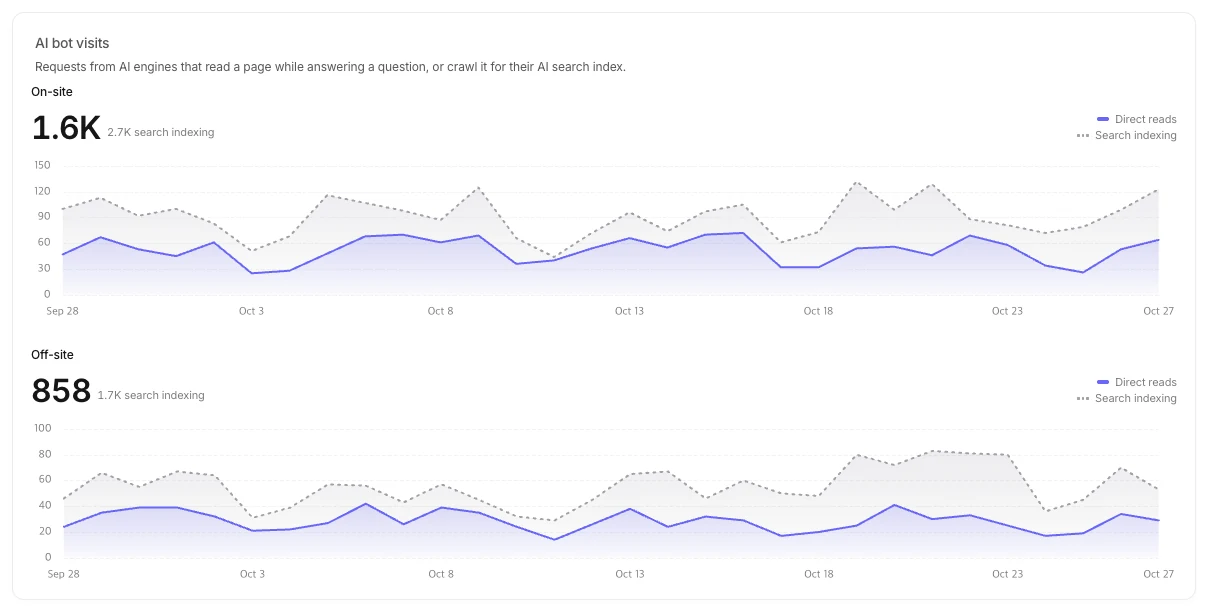 The big number and solid line are Direct reads; the dashed line is Search indexing. The example uses a fictional brand.
- The big number and the solid line are Direct reads.
- The dashed line and the small number next to the big one are Search indexing.
- On-site and Off-site are shown one above the other.
- Switch the period at the top right (7d, 30d, 60d, 90d) and the card follows right away.
Direct reads: pages opened to answer someone's question
This counts the times an AI opened your page on the spot to answer a question a person asked. It is the clearest sign that your pages are being used in real answers, so it is the big number. Five bots are counted.
- ChatGPT-User: used when ChatGPT or a GPT visits a web page to answer a question.
- Claude-User: used when Claude opens a page to answer a user's question.
- Perplexity-User: used when Perplexity visits a page to build an answer and link to it.
- MistralAI-User: used when Mistral's AI assistant visits a page to answer and link to it as a source.
- DuckAssistBot: used when DuckDuckGo's AI-assisted answers read source pages in real time.
These bots don't roam the web on their own. They open a page only when someone has asked a question.
Search indexing: pages collected ahead of AI search answers
This counts the times an AI search engine crawled your page for its search index. Pages in that index become candidates for AI search answers. Four bots are counted.
- OAI-SearchBot: crawls to surface sites in the results of ChatGPT's search features.
- Claude-SearchBot: crawls pages for Claude's search results.
- PerplexityBot: crawls to surface and link sites in Perplexity's search results.
- Amzn-SearchBot: crawls so pages can appear in Amazon search experiences such as Alexa.
What is counted, and what isn't
- On-site counts the pages Anymorph serves on your site.
- Off-site counts only your articles on Anymorph editorial sites. The site's home page, listings, other brands' articles and blog posts on platforms such as Tistory are not counted.
- Only requests the page answered successfully are counted, so probes for missing files under a borrowed bot name drop out.
- Crawlers that collect data for AI model training (GPTBot, ClaudeBot, CCBot and others) and classic search crawlers (Googlebot, Bingbot) are not counted.
- Days are in UTC and run through yesterday. A side with no pages to measure says so instead of showing 0.
Try it
- Steady Direct reads mean your pages are being used in real questions. Open the Citations tab to see which answers cited them.
- Search indexing with few Direct reads can mean AI search knows the page but doesn't use it in answers often yet.
- If both numbers stay near 0, check that your site's robots.txt doesn't block OAI-SearchBot, PerplexityBot or Claude-SearchBot. OpenAI and Perplexity recommend allowing these bots to appear in their search results.
Get the next update by email
When a new update ships, we send it to you in one email.