
AI Visibility Score Formula for Executive GEO Dashboards
A usable score combines four inputs (coverage, mentions, citations, and competitor share) and is reported weekly by engine and monthly overall.


Key takeaways
- AI-referred visitors can convert far better than organic ones (15.9% against 1.76% in one Seer Interactive case study), so AI visibility needs its own four-input score.
- The formula measures coverage, mentions, citations, and competitor share across multiple engines.
- Operations teams use this standardized framework to analyze cross-engine performance and avoid flattened vanity metrics.
What should a single AI visibility score measure?
An effective AI visibility score quantifies brand presence by aggregating query coverage, citation counts, mention frequency, and competitor share across language models.
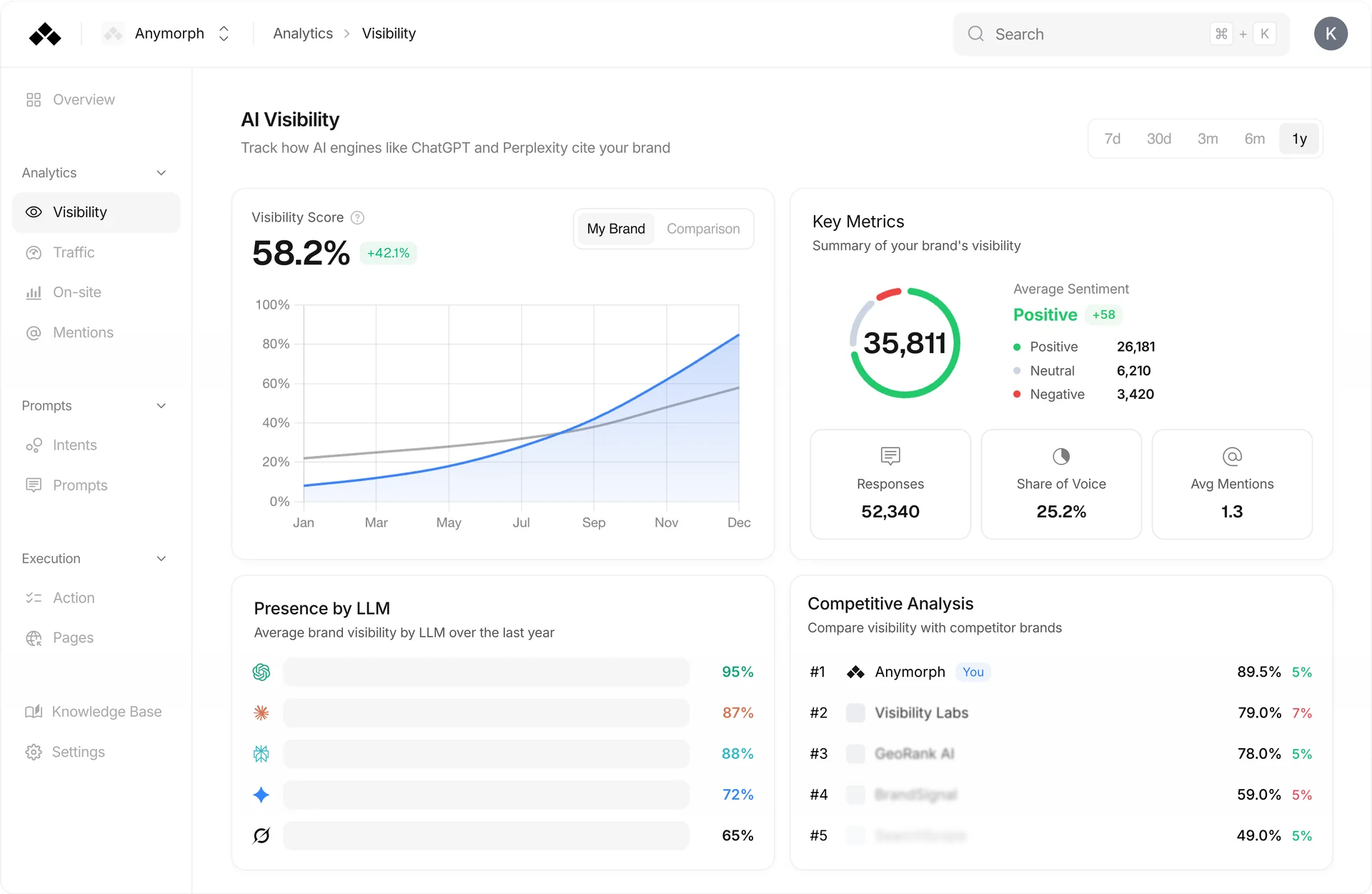
Generative Engine Optimization (GEO) requires exact tracking mechanisms to capture commercial market share. Traditional SEO platforms cannot process the unstructured nature of large language model (LLM) responses. Without a standardized score, executive dashboards fail to capture actual brand reach across fragmented AI ecosystems.
A single composite metric is necessary for leadership reporting, but it becomes a liability if it obscures engine-by-engine volatility. For example, a brand might achieve high visibility on ChatGPT while remaining entirely absent from Google AI Overviews or Perplexity. Anymorph analytics separate these inputs so marketing operations can isolate performance drops on specific engines. This multi-engine tracking methodology ensures that the single AI visibility score presented to the C-suite accurately reflects total market penetration rather than a skewed, single-platform snapshot.
How do actionable GEO metrics differ from vanity metrics?
In Ahrefs' study of 75,000 brands, brand web mentions correlated with Google AI Overview visibility far more strongly (0.664) than backlinks did (0.218), so GEO measurement should track mentions rather than backlink counts (Ahrefs, 2025).
Traditional search dashboards rely on positional ranking and domain authority, which hold little value for AI answer engines. Contemporary reporting shifts resource allocation toward direct mention acquisition. Data confirms that brand mentions correlate three times more strongly with AI visibility than traditional backlinks (Omnibound, 2026). To track what genuinely impacts pipeline, organizations must evaluate specific source overlaps, geolocation analytics, and engine-level sentiment instead of outdated link profiles.
| Metric Type | Actionable GEO Metric | Vanity SEO Metric | Reporting Note |
|---|---|---|---|
| Awareness | Prompt Coverage | Keyword Search Volume | Coverage tracks the actual trigger rate in AI engines, ignoring standard search intent. |
| Authority | Citation Density | Domain Authority | Citations prove the LLM trusts your specific data sources over third-party aggregators. |
| Reach | Brand Mentions | Ranking Position | Mentions correlate strongly (0.664) with AI Overview visibility in Ahrefs' study and measure direct brand inclusion. |
| Market Share | Competitor Share of Voice | Share of Search | Share of voice measures your narrative presence against direct commercial rivals. |
Replacing vanity metrics with actionable GEO KPIs requires rebuilding the marketing dashboard from the ground up. This structural change aligns measurement directly with the inputs that language models use to construct their answers.
What is the exact formula for AI visibility?
A practical formula takes a weighted average of four rates measured on the same prompt set: coverage, mentions, citations, and competitor share.
Executives need math they can audit, so express every input as a percentage of the same prompt set and publish the weights. One way to write the calculation:
AI Visibility Score = w1 × Coverage + w2 × Mentions + w3 × Citations + w4 × Competitor Share, where the four weights add up to 1
Each input answers a different question:
- Coverage: The share of tracked prompts whose answers include the brand at all.
- Mentions: How prominently the brand appears in those answers, such as how often it is named and whether it comes first.
- Citations: The share of answers that link to the brand's own pages as a source.
- Competitor Share: The brand's share of all mentions among the tracked competitors on the same prompts.
Start with equal weights of 0.25 and change them only when the team agrees which input matters most for the quarter.
High scores on these inputs can pay off in the pipeline. In a single-site case study, Seer Interactive found that ChatGPT visitors converted at 15.9% against 1.76% for Google organic, although AI traffic was only 0.07% of organic sessions (Seer Interactive, 2026). This conversion superiority justifies the engineering resources required to implement a continuous 4-input tracking model.
Which measurement pillars dictate AI market share?
Four diagnostic signals explain why the score moves: citation density, sentiment, link-through rate from cited answers, and how often the brand leads answers to long-tail questions.
Anymorph reports these signals by engine and by intent type, so a drop in one of them shows up before it moves the overall score.
In the Princeton GEO study, adding quotations, statistics and source citations raised visibility by up to 40% within the study's benchmark (Aggarwal et al., 2024). A separate Yext study of 6.8 million citations found that brand websites accounted for 44% and listings for 42%, totaling 86%. Reviews and social media accounted for another 8%; they are not part of that 86%. Yext studied location-specific queries across ChatGPT, Gemini and Perplexity, so these proportions are not a benchmark for every B2B SaaS prompt set (Yext, 2025).
What workflow supports brand presence across AI engines?
Managing an AI visibility score requires continuous prompt-set governance, citation exports, and dashboard quality assurance across multiple AI engines.
Compiling a reliable KPI demands rigorous operations. Marketing teams must manage high-volume prompt tracking—often executing hundreds of queries per day—to capture accurate samples of engine outputs. The workflow begins with defining a static prompt set mapped to commercial intents, followed by automated collection of the answers users actually see in engines like ChatGPT, Gemini, and Perplexity.
Once extracted, the system parses the text for mentions, measures sentiment weight, and calculates source overlap against competitors. Because AI engines change their answers often, single-platform snapshots provide incomplete data. Anymorph automates this collection and parsing and rolls the results into one executive view.
How frequently should teams report AI search analytics?
Marketing operations must monitor citation shifts on a weekly basis while presenting aggregated 90-day visibility trend lines to executive leadership monthly.
The volatility of LLM algorithmic updates dictates a bifurcated reporting structure. Tactical teams require high-frequency weekly alerts to catch sudden platform deprecations or shifts in training data preferences. For instance, ChatGPT's citation share for Reddit plummeted from 60% to 10% in late 2025 over just a few weeks (ALM Corp, 2025/2026). A brand relying heavily on Reddit for its contextual citation density would have lost significant market share instantly.
Conversely, a monthly review cycle fits executive needs. Leadership dashboards should pair the overall weighted visibility score with specific performance bars for major engines (Medium / Joachim, 2026). This ensures that the executive team sees the strategic progression of the campaign without overreacting to the micro-fluctuations inherent to weekly AI model testing.
FAQS
Frequently asked questions
What is a good AI citation rate for B2B SaaS marketing?
A good citation rate depends on the category and the prompt set, so benchmark it against the competitors tracked on the same prompts. Yext's location-specific study attributed 86% of citations to websites and listings; that source distribution does not set a target citation rate for B2B SaaS. Adding statistics, quotations and cited sources improved visibility in the Princeton GEO benchmark, but the measured lift does not guarantee a result for a particular site.
How often should marketing leaders review AI search visibility?
Marketing leadership should review aggregate visibility scores monthly while keeping a 90-day trailing trend line visible. Operational teams require weekly tracking to monitor volatile citation sources, as demonstrated when Reddit citations dropped from 60% to 10% rapidly in 2025. This dual-speed cadence ensures executives see stable trends while operators catch abrupt algorithm adjustments.
Which AI prompt tracking tool handles 500 prompts per day?
Enterprise measurement platforms can run hundreds of prompts a day across multiple AI engines. Anymorph runs prompt sets daily across ten AI engines, collects the answers users actually see, and parses each one for mentions, citations, sentiment, and competitor share.
Why do traditional SEO vanity metrics fail in generative engine optimization?
In Ahrefs' study of 75,000 brands, backlinks showed a weak 0.218 correlation with brand visibility in Google AI Overviews, while brand web mentions showed 0.664 (Ahrefs, 2025). Backlink counts alone say little about AI visibility, so tracking needs mention-based inputs.
What are the most heavily weighted generative engine optimization KPIs?
The four most critical KPIs are prompt coverage, mention frequency, citation counts, and competitor share of voice. Visitors who arrive from AI answers can convert well above organic search; one Seer Interactive case study measured 15.9% for ChatGPT against 1.76% for Google organic. Marketing teams use these specific inputs to calculate the overall visibility score and isolate which specific platforms require tactical adjustments.
Building your own tracker instead? querying.ai returns real-browser answers from 11 AI engines, including ChatGPT, Gemini, Perplexity and Google AI Overviews, as structured JSON. Plans start at $20/month, and sign-up includes 500 free credits.
Related reading



See how Anymorph tracks visibility across AI engines
Compare plans and see how your brand shows up across AI engines.