
SEO vs GEO for Startups With a Limited Budget: What to Do First
A practical guide for 10-person SaaS teams comparing SEO vs GEO, quick wins, and the cheapest way to build AI search visibility.
Why Startups Are Shifting Budgets to AI Search
The traditional organic search model is failing small teams. Traditional organic click-through rates (CTR) have plummeted from 45% in 2015 to an estimated 25% in 2026. This collapse is largely driven by the ubiquity of zero-click AI Overviews. Conversely, daily AI search usage is projected to reach 52% by August 2026, solidifying it as the primary discovery layer for informational and transactional queries. Transitioning to a comprehensive AI Search Playbook for SEO-First Companies allows startups to intercept high-intent buyers exactly where they are currently asking questions.
Declining Traditional CTR
Traditional organic click-through rates have dropped significantly due to zero-click AI Overviews.
Daily AI Search Usage
Projected daily usage by August 2026, making it the primary discovery layer.
Higher Conversion Rate
Visitors from AI search convert into signups at twenty-three times the rate of standard organic traffic.
The ROI of GEO vs Traditional SEO
For a startup managing runway, the efficiency of every single website visitor is paramount. Because AI search queries are highly specific and conversational, the users who do click through from AI citations carry massive purchase intent. ChatGPT traffic converts at 24%, which is 6x higher than standard Google traffic as of 2026.
This downstream efficiency impacts the entire sales funnel. Beyond just top-of-funnel conversions, leads attributed to GEO efforts result in 30–40% higher close rates and exhibit a 25% shorter sales cycle compared to traditional SEO leads.
| Metric | Traditional SEO | Generative Engine Optimization (GEO) |
|---|---|---|
| Average CTR | 25% (Declining) | Lower volume, but hyper-targeted intent |
| Signup Conversion Rate | Baseline | 23x higher than traditional organic |
| ChatGPT Specific Conversion | 4% (Google baseline equivalent) | 24% |
| Sales Cycle Impact | Standard | 25% shorter sales cycle |
| Close Rate | Standard | 30–40% higher close rate |
Visibility in Days, Not Months
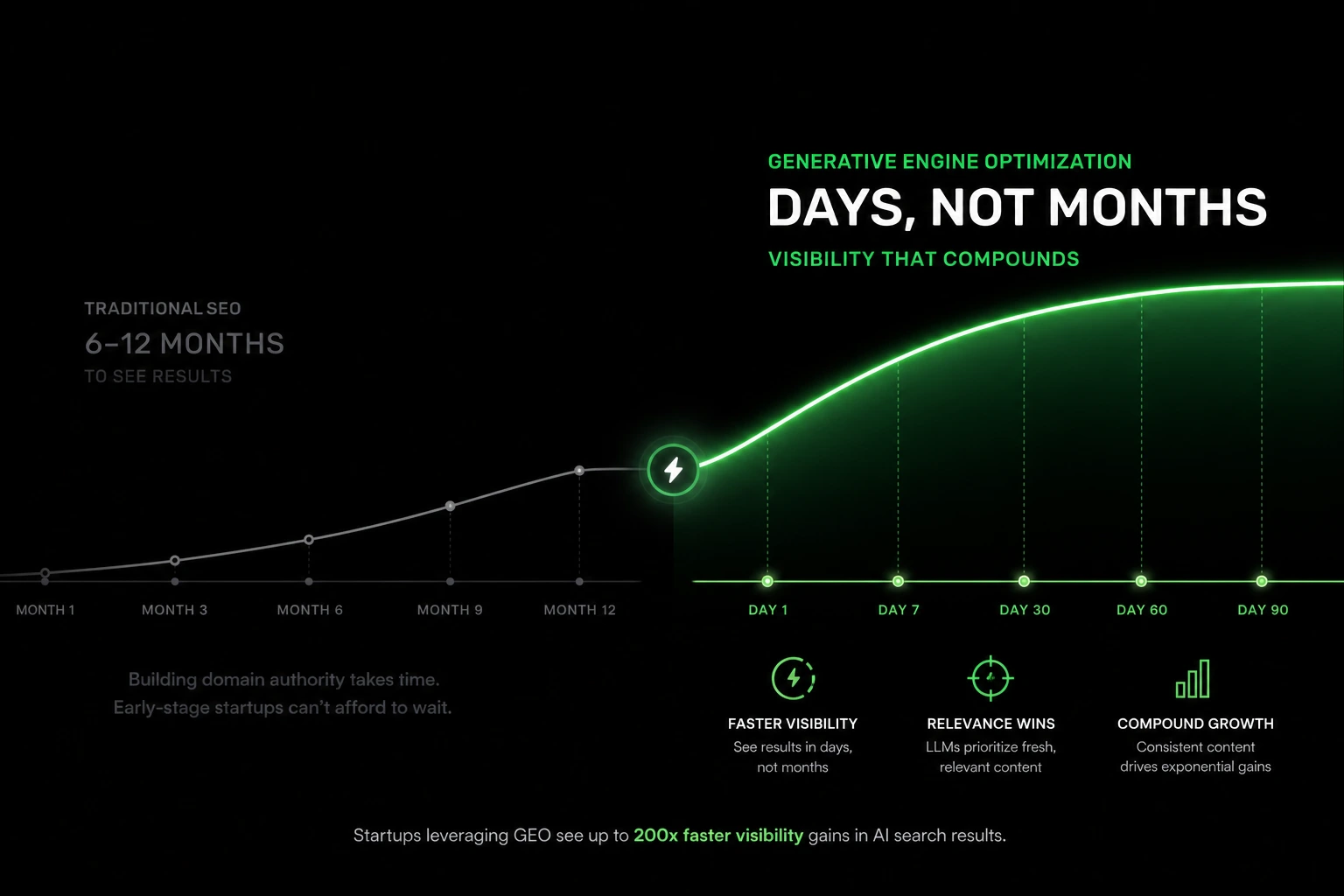
Generative Engine Optimization generates brand visibility within days, bypassing the six to twelve months required for traditional SEO returns. Building domain authority organically typically requires 6 to 12 months of consistent effort and spending before a startup demonstrates tangible ROI. For early-stage companies with 18 months of runway, waiting a year for marketing channels to activate is often fatal.
Because LLMs prioritize recent, highly relevant information over legacy domain authority, startups lacking established metrics can achieve visibility almost immediately. Brands executing a 90-Day GEO Strategy for SaaS by publishing 12 or more optimized pieces of digital content monthly can experience up to 200x faster visibility gains in AI search results.
How to Allocate Your Search Budget
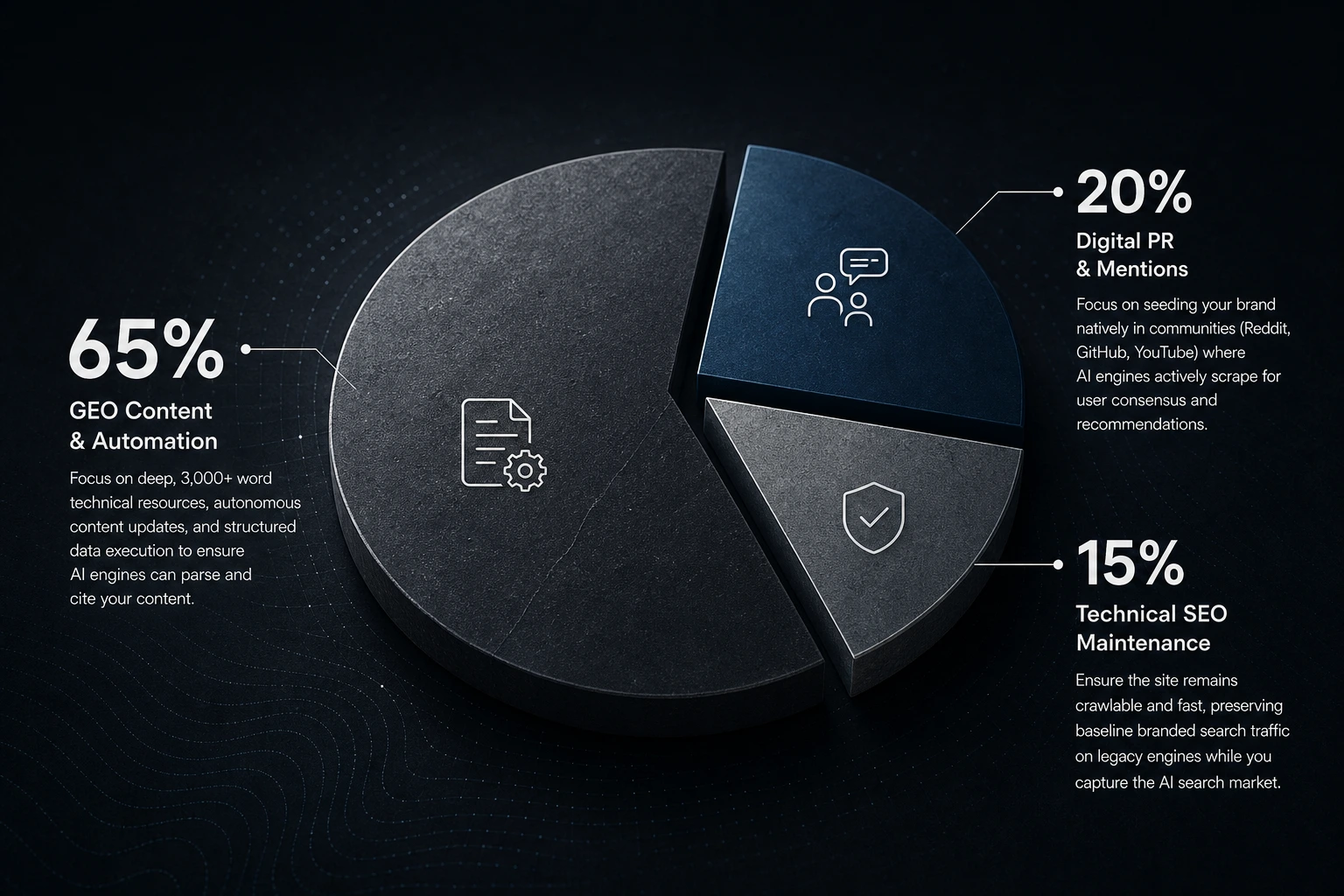
Resource-constrained SaaS teams should allocate 60 to 70 percent of their initial search budget to GEO to secure a first-mover advantage. Balancing two search paradigms simultaneously requires discipline. While it is dangerous to abandon traditional search entirely, the GEO Strategy by Company Stage for B2B SaaS Teams shifts aggressively toward AI discovery.
GEO Content & Automation
Focus on deep, 3,000+ word technical resources, autonomous content updates, and structured data execution to ensure AI engines can parse and cite your content.
Digital PR & Mentions
Focus on seeding your brand natively in communities (Reddit, GitHub, YouTube) where AI engines actively scrape for user consensus and recommendations.
Technical SEO Maintenance
Ensure the site remains crawlable and fast, preserving baseline branded search traffic on legacy engines while you capture the AI search market.
The Hidden Cost of Manual GEO
When evaluating the Best Generative Engine Optimization (GEO) Tools, startups will find that software costs are accessible (starting at $39/month). However, the manual production of comprehensive AI-optimized content remains expensive. Quality GEO content costs between $800–$3,000 per piece because it requires extreme depth, custom structured data, and continuous monthly updates.
Automate your AI visibility strategy
Startups cannot win the AI search game by throwing expensive agency labor at the problem. Anymorph serves as an autonomous website OS that bridges this exact budget gap. Rather than manually researching, writing, structuring, and updating pages, Anymorph creates and maintains on-brand content automatically.
See How Anymorph WorksFrequently Asked Questions
What is the fastest way for a startup to get cited in ChatGPT?
The fastest path to AI citation is generating branded mentions on credible third-party platforms like Reddit, YouTube, and specialized industry forums. AI engines scrape these platforms constantly for user consensus. Combining this off-site PR with a high-velocity publishing strategy (12+ pieces a month) can yield visibility in days.
Should we abandon traditional SEO completely?
No. Traditional SEO still accounts for legacy brand search and foundational web presence. However, startups should transition their budget allocation to 60-70% GEO and 30-40% SEO. This ensures you maintain baseline traffic while aggressively capturing the high-converting AI search market before it saturates.
Why is GEO content so expensive to produce manually?
To be cited by an AI engine, content must be undeniably authoritative. This requires manual pieces to be 3,000 to 5,000 words long, feature expert subject matter interviews, include custom structured data, and receive continuous monthly updates to remain "fresh" in the eyes of the LLM. This pushes manual production costs to $800–$3,000 per piece.
Can a 10-person startup really outrank an enterprise competitor in AI search?
Yes. Unlike traditional search engines that heavily weight legacy Domain Rating and decades of accumulated backlinks, AI engines prioritize the immediate relevance, factual density, and recent consensus of the content. If a startup provides a more direct, structured, and accurate answer to a prompt than an enterprise competitor, the AI will cite the startup.