
How to Make Product Documentation Citable in AI Search
Optimizing product documentation for generative engines requires distinct architectural shifts compared to traditional SEO. By implementing answer-first formatting, migrating to semantic HTML, and applying enterprise-grade schema, brands can dramatically increase their AI visibility.
Why is AI search optimization critical for product documentation?
AI search optimization ensures your technical documentation is extracted, cited, and recommended by large language models responding to user queries.
Historically, product documentation served as a passive repository for existing users. Today, developers, engineers, and software buyers actively use tools like ChatGPT, Perplexity, and Google AI Overviews to troubleshoot issues, compare technical capabilities, and evaluate software architectures. If your help center is not optimized for these Generative Engine Optimization (GEO) standards, AI models will either hallucinate answers about your product or cite your competitors instead.
Anymorph analysis shows that the structural requirements for AI bots vastly differ from human readability standards. Generative engines do not parse narrative flow; they look for high-density, cleanly structured information blocks. To capture this traffic, documentation teams must transition from writing long-form manuals to creating modular, distinct answer capsules that AI systems can effortlessly extract.
For a broader understanding of how these engines decide which brands to highlight, reviewing How AI Engines Recommend Brands: ChatGPT, Perplexity, Google AI, and Claude provides crucial context on algorithmic preferences.
How should you structure lead paragraphs for AI bots?
Lead paragraphs in technical content must be strictly constrained to 40 to 60 words to significantly improve data extraction rates for AI.
When an AI engine crawls a documentation page, it allocates limited computational resources to understand the core premise of the document. Rambling introductions, historical context, or marketing fluff at the top of a page actively dilute semantic relevance. If the bot cannot determine the exact purpose of the page within the first few sentences, it will move on to a clearer source.
According to a recent analysis of AI crawling behavior, lead paragraphs in technical documentation should be strictly constrained to 40–60 words to significantly improve extraction rates (AI Visibility: How to Write Technical Content That AI Systems Will Cite, 2024).
By condensing your introduction into a dense, keyword-rich summary of the page's exact technical utility, you lower the cognitive load on the language model. If you are unsure how your current documentation performs against this metric, you can learn How to Audit Content for AI Search Readiness to establish a baseline.
What is the impact of answer-first formatting?
Answer-first formatting places the direct response at the very beginning of a section, drastically increasing your visibility in AI snippets.
Traditional technical writing often builds up to a conclusion, offering prerequisites and context before delivering the solution. In the era of generative search, this inverted pyramid is actively harmful to citation rates. AI engines prioritize content that minimizes the effort required to identify a direct answer to a specific prompt.
Moving the direct answer to the very beginning of a section—rather than burying it under narrative context—increases featured snippet visibility from a baseline of 8% to 24% (AI Visibility: How to Write Technical Content That AI Systems Will Cite, 2024). This up to 16% total increase in visibility represents a massive leap in unbranded search acquisition.
Every H2 or H3 in your documentation should immediately be followed by a definitive, standalone sentence that answers the implied question of the heading.
How do structured tables improve AI citation rates?
Using structured tables with clear headers yields vastly higher citation rates than burying technical specifications in narrative descriptions.
Large language models excel at processing structured matrices. When users ask AI for API limits, integration capabilities, or pricing tiers, the engine looks for the most organized data format available.
Product documentation that utilizes tables with clear headers achieves 2.5x higher citation rates than purely narrative descriptions (AI Visibility: How to Write Technical Content That AI Systems Will Cite, 2024). However, Anymorph recommends a hybrid approach. Because some AI systems still face edge-case challenges with complex table parsing, you must pair these tables with descriptive supporting text.
| Data Format | AI Parsing Efficiency | Best Used For |
|---|---|---|
| Narrative Text | Low for specific data points | Conceptual overviews, use cases |
| Markdown Lists | Medium | Step-by-step guides, prerequisites |
| Structured Tables | High (2.5x citation rate) | API endpoints, feature matrices, limits |
| Hybrid (Table + Text) | Maximum | Complex technical specifications |
Which technical formats do AI crawlers prefer?
AI crawlers heavily prefer structured HTML with semantic tags over raw Markdown files because it provides clearer context for data extraction.
Developer-first documentation platforms heavily rely on Markdown for its simplicity and version control compatibility. While Markdown is excellent for human contributors, it strips away the semantic layers that AI crawlers use to understand the hierarchy and relationship of technical concepts.
A 2024 log analysis of major AI bots, including GPTBot and ClaudeBot, found no evidence that they prioritize raw Markdown files. Instead, documentation must be published as structured HTML utilizing semantic tags to ensure better visibility. Tags like <article>, <section>, <aside>, and precise <hn> hierarchies give models the structural roadmap they need.
For teams managing massive knowledge bases, upgrading this infrastructure requires careful planning. Reviewing the Technical Architecture of GEO Implementation for a Large Website can guide this HTML migration.
How does schema markup influence AI indexing?
Implementing specific semantic schema types enables AI engines to accurately categorize, index, and cite technical articles more frequently.
Schema markup acts as a direct API to search engines, and this is doubly true for generative AI. Unstructured text forces the model to guess the purpose of a page; schema explicitly tells it.
The use of specific schema types—specifically FAQPage, HowTo, and TechArticle—is essential for securing citations. In a controlled 2024 experiment, pages with well-implemented schema were indexed and cited up to 58% more frequently.
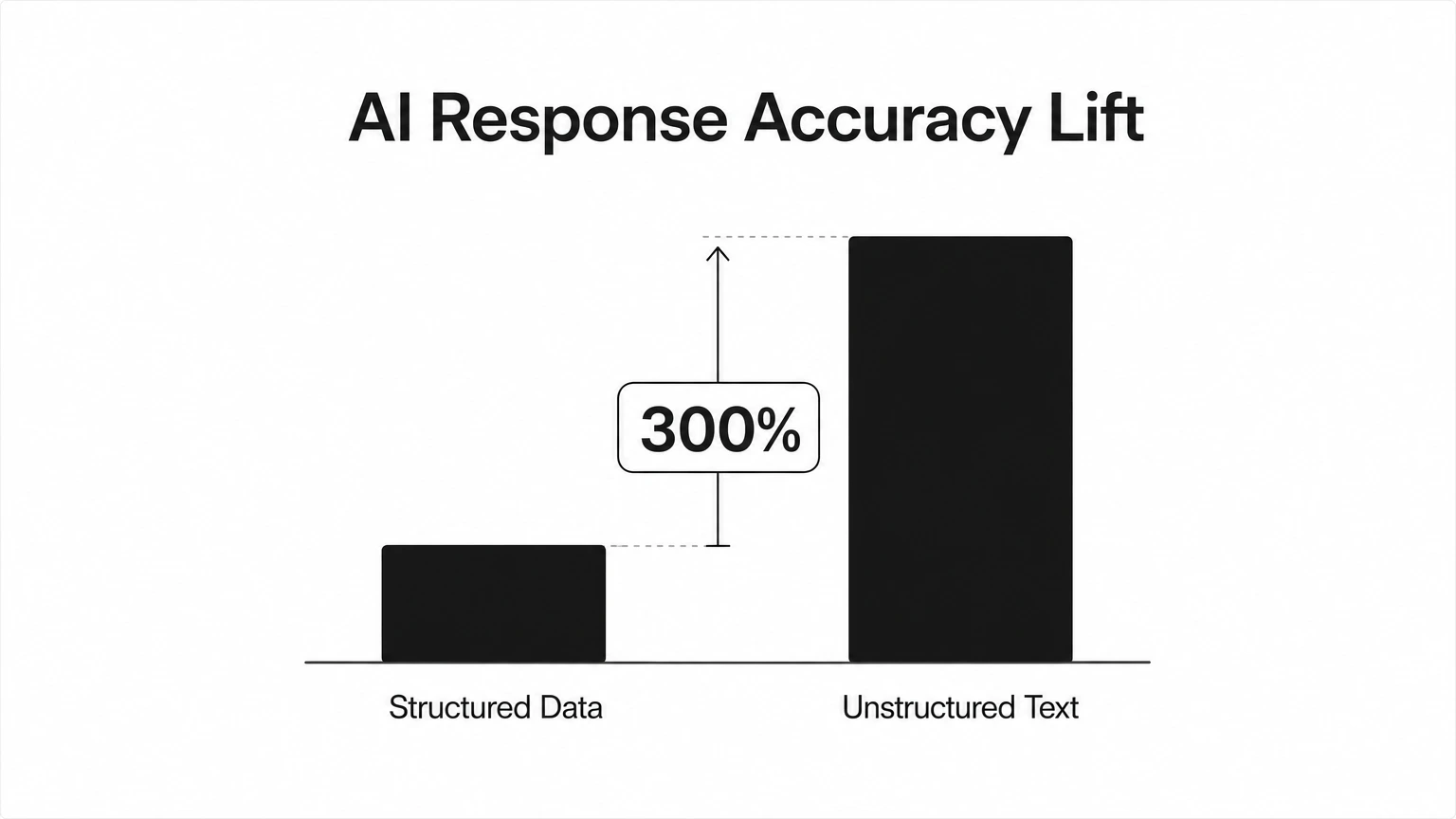
Furthermore, scaling this into a comprehensive knowledge graph transforms how AI views your brand. Grounding enterprise content in knowledge graphs and structured data, rather than relying on unstructured text, can improve generative AI response accuracy by an astounding 300% (Schema Markup for AI Citations: The Technical Implementation Guide, 2024).
Why does content freshness matter for AI citations?
Generative engines actively prioritize recently updated technical documentation to ensure they provide users with the most current information.
Unlike static informational queries, software documentation is inherently volatile. APIs deprecate, interfaces update, and new features roll out monthly. AI models are programmed to heavily penalize outdated technical content to avoid surfacing broken instructions to users.
Freshness is a critical ranking signal. For ChatGPT specifically, 76.4% of the most-cited pages were updated within the last 30 days. Maintaining a recent "Last Updated" timestamp and actively refreshing documentation is mandatory for sustained AI visibility.
Additionally, trust markers within that fresh content matter. Including specific statistics within documentation increases AI citation visibility by 22%, while incorporating expert quotations from named technical sources provides a 37% lift in the likelihood of the content being cited.
How do citation sources differ across AI platforms?
Different artificial intelligence platforms rely on vastly different source materials and domains when generating technical responses for users.
A monolithic approach to GEO will fail because ChatGPT, Perplexity, and Google's AI evaluate credibility differently. You cannot optimize documentation in a vacuum; you must ensure your technical concepts are corroborated across the broader web.
As of April 2026, data reveals stark contrasts in platform behavior: ChatGPT relies on Wikipedia for 7.8% of its citations, whereas Perplexity draws a massive 46.7% of its top citations from Reddit (ChatGPT vs. Perplexity vs. Google AI Mode: The B2B SaaS Citation Benchmarks Report (2026), 2026).
Because of this variance, multi-platform presence is non-negotiable. Research from 2025 shows that brands mentioned on four or more distinct platforms are 2.8 times more likely to appear in ChatGPT responses compared to brands found on only a single platform. Ensure your documentation is linked and discussed on developer forums, Reddit, and GitHub.
What is the business ROI of AI-optimized documentation?
Transforming your help center into AI-optimized natural language guides directly accelerates product adoption and increases pipeline generation.
Historically, product documentation was viewed strictly as a customer success expense—a way to deflect support tickets. Generative AI has transformed the help center into a primary top-of-funnel acquisition channel. When technical buyers evaluate SaaS products, they ask AI engines highly specific implementation questions. If your documentation answers those questions clearly, you win the technical evaluation before speaking to sales.
Restructuring technical documentation is not merely a technical exercise; it has a direct impact on the sales funnel. Restructuring help centers into comprehensive guides designed for natural language queries has been shown to drive a 32% increase in sales-qualified leads (SQLs), as demonstrated by a case study of a prop-tech SaaS.
To map out how this impacts your broader commercial strategy, our Generative Engine Optimization for AI Product Companies (Playbook + Page Types) outlines the exact transition frameworks required.
Frequently Asked Questions
What is the most critical schema type for product documentation?
TechArticle, FAQPage, and HowTo are the three most critical schema types. Implementing these correctly gives generative engines the exact structured data they need to parse technical specifications, step-by-step instructions, and common user queries without hallucinating.
Should we completely abandon Markdown for our documentation?
No, developers can still write in Markdown for version control and ease of use. However, your static site generator or CMS must render that Markdown into fully structured, semantic HTML upon publishing. AI crawlers need semantic HTML tags to understand document hierarchy.
How frequently do we need to update our documentation for AI?
To maintain high citation rates, especially in ChatGPT, technical pages should ideally be updated every 30 days. Freshness is a major credibility signal for AI models, as they are actively trained to avoid citing deprecated technical instructions.
Why is Perplexity citing Reddit instead of our official documentation?
Perplexity heavily favors crowd-sourced, experiential answers for troubleshooting queries, drawing nearly half of its citations from platforms like Reddit. To counter this, ensure your official documentation uses conversational, natural language problem-solving formats and actively distribute links to your documentation within relevant developer communities.
Turn your technical documentation into a competitive advantage
Partner with Anymorph to structure your technical documentation precisely for the generative engines that your potential buyers use every day. Your product's capabilities only matter if the market—and the AI engines advising the market—understand them.
Leaving your documentation unoptimized means surrendering technical authority to competitors who have structured their data for extraction. Anymorph provides the architectural blueprints, schema implementation, and content restructuring required to dominate AI citations.