
Generative Engine Optimization for AI Product Companies
Scale citable pages and improve AI search visibility. Learn the GEO playbook to get cited by ChatGPT, Perplexity, and Gemini while reducing hallucinations.
of B2B buyers start research through AI interfaces
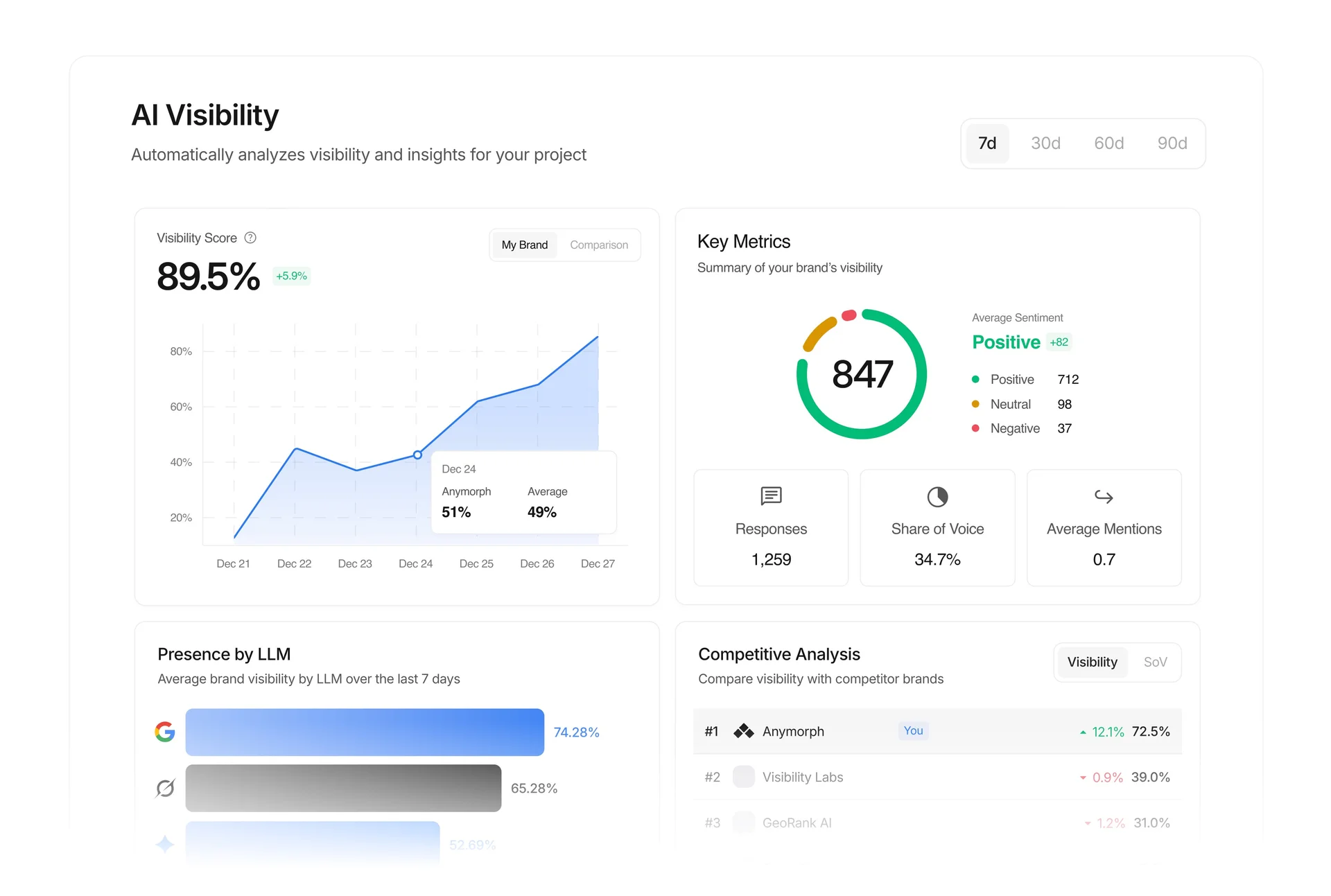

Why is your AI product invisible to other generative engines?
Traditional SEO is failing AI startups because LLMs don't rank 'blue links'; they synthesize answers. If your content is trapped behind heavy scripts or lacks semantic structure, AI crawlers like ChatGPT-User will ignore your data or, worse, fabricate incorrect specs.
This leads to Citation Fragmentation. Without a dedicated GEO strategy, you aren't just losing rankings—you're losing the primary discovery channel where 58% of consumers now find product recommendations in 2026.
How does Anymorph secure your brand's authority in AI search?
Anymorph transforms your technical assets into a 'citable' format that AI engines prioritize by focusing on Information Alignment and Entity Clarity. Our framework optimizes for Retrieval-Augmented Generation (RAG), providing clear, direct answers that LLMs can extract and attribute to your brand.
- Semantic Intent Mapping Aligning content with 'Query Fan-Out' sub-queries.
- Schema Reinforcement Prevent specification drift with deep metadata.
- Knowledge Graph Integration Solidifying your brand entity in model data foundations.
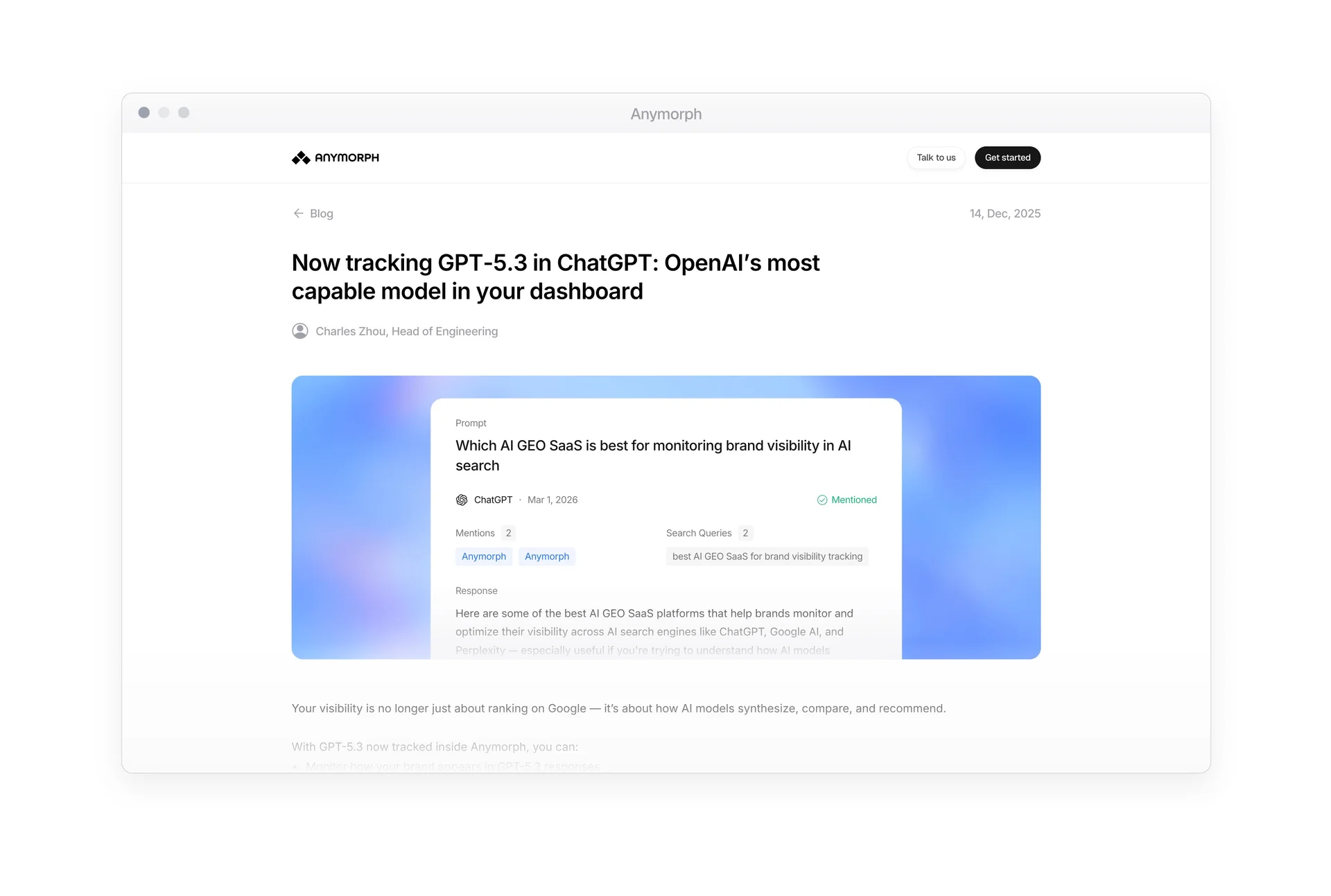
Which page types are essential for AI visibility?
To dominate citation share, AI companies must deploy specific page architectures designed for machine ingestion. These pages serve as the 'truth layer' for generative models.
Technical Benchmarks
Original data and performance metrics that AI models cite as authoritative evidence.
Comparison & Alternative Hubs
Structured tables that resolve 'Best [Category] AI' prompts with factual differentiators.
Integration & Workflow Guides
Documentation explaining how your product fits into the user's AI stack (e.g., LangChain or Vercel AI SDK).
Definition Clusters
Concise 1-2 sentence summaries followed by deep-dive guides that LLMs love to quote.

How can you stop AI engines from hallucinating your technical specs?
To stop hallucination rates from damaging buyer trust, utilize a Five-Step Audit Cycle that diagnoses inaccuracies and reinforces accurate facts within Knowledge Graphs. Passive documentation is a liability.
Anymorph replaces flat embeddings with Structured Context, ensuring AI agents navigate your technical catalog with 100% precision. By implementing 'agent configs' and skill boundaries, we instruct models on when to fall back to your official documentation rather than guessing based on semantic similarity.
Frequently Asked Questions
What is the primary difference between SEO and GEO for AI companies?
SEO focuses on keyword rankings and 'blue links,' while GEO (Generative Engine Optimization) focuses on 'Information Alignment' to ensure your brand is cited as the primary source within a text summary generated by an LLM.
Does GEO help prevent AI models from lying about my product?
Yes. By using structured data, schema markup, and Knowledge Graph reinforcement, GEO provides a 'truth layer' that reduces hallucination rates (which can be as high as 52%) by giving models verified paths to your technical specs.
How long does it take to see results from a GEO campaign?
While traditional SEO can take 6 months, autonomous GEO platforms like Anymorph provide near-instant insights, while structured pilot programs typically show citation impact within 90-120 days.
Protect Your Citation Share and Brand Accuracy
Stop losing 2026 buyers to AI hallucinations or competitor recommendations. Our GEO platform identifies the technical gaps blocking AI crawlers and builds the citable pages you need to dominate the AI-mediated marketplace.