
How to Pitch GEO to a Marketing VP Using the AI Search Discovery Shift
Traditional search volumes are facing a projected 25% decline by the end of 2026. To protect market share, modern marketing teams must pivot to Generative Engine Optimization (GEO).
Executive Summary
Traditional search volumes are facing a projected 25% decline by the end of 2026, while AI-powered answer engines handle billions of monthly queries. Pitching this to a VP requires demonstrating the failure of the click-based model, highlighting that 86% of AI citations come from brand-controlled sources, and utilizing the proven D.E.E.P. framework to secure budget and executive buy-in.
What is the AI search discovery shift?
The AI search discovery shift is the rapid transition of consumers moving from traditional click-based search engines to AI-powered answer engines.
For the past two decades, marketing leadership has relied on a predictable formula: rank high on a search engine results page (SERP), capture clicks, and convert traffic on-site. As of 2026, this landscape has fundamentally fractured. Traditional search engines are experiencing a projected 25% decline in volume this year as users transition toward direct-answer interfaces.
When pitching a Generative Engine Optimization initiative to your marketing VP, establishing the sheer scale of this consumer behavior change is the mandatory first step. This is not a future trend; it is a current reality. The transition is driven by AI referral traffic experiencing 357% year-over-year growth as of June 2025. AI platforms reached over 7 billion monthly visits by 2025, while generating more than 1.1 billion referral visits.
Nearly 60% of consumers reported using AI tools for product discovery and shopping assistance as of 2025. Executive leadership often views new marketing frameworks as optional add-ons, but the discovery shift framing proves that adopting GEO is a necessary evolution to maintain existing market share. The reality is stark: 72% of marketing leaders believe AI search will impact customer acquisition more than traditional SEO as of 2025.
Why is traditional SEO failing in the era of zero-click searches?
Traditional SEO fails today because AI answer engines deliver direct responses, creating a zero-click environment that bypasses standard web links. Zero-click searches rose to an overwhelming 69% in 2025.
| Metric | Traditional SEO | Generative Engine Optimization (GEO) |
|---|---|---|
| Primary Goal | Rank #1 on SERP for target keywords | Become the primary cited source in AI answers |
| User Behavior | Scroll, click, and browse multiple tabs | Ask a complex prompt, read a single synthesized answer |
| Success Metric | Organic traffic volume and Click-Through Rate | Brand inclusion rate, citation frequency, and sentiment |
| Content Focus | Keyword density, search intent, and backlinks | Semantic richness, verifiable statistics, and expert entities |
How does the AI visibility gap affect brand market share?
The AI visibility gap occurs when brands that rank highly in traditional search fail to earn citations from generative AI engines like ChatGPT.
One of the most dangerous assumptions marketing VPs make is believing that their current dominance in traditional search will automatically translate to dominance in AI search. This is mathematically false. AI engines are highly fragmented; they utilize different training data, different retrieval-augmented generation (RAG) models, and do not cite the same sources.
Data from 2025 shows only an 11% overlap in the domains cited by ChatGPT and Perplexity for identical queries. A brand winning aggressively on one engine may be entirely invisible on another, creating a massive vulnerability in your customer acquisition pipeline.
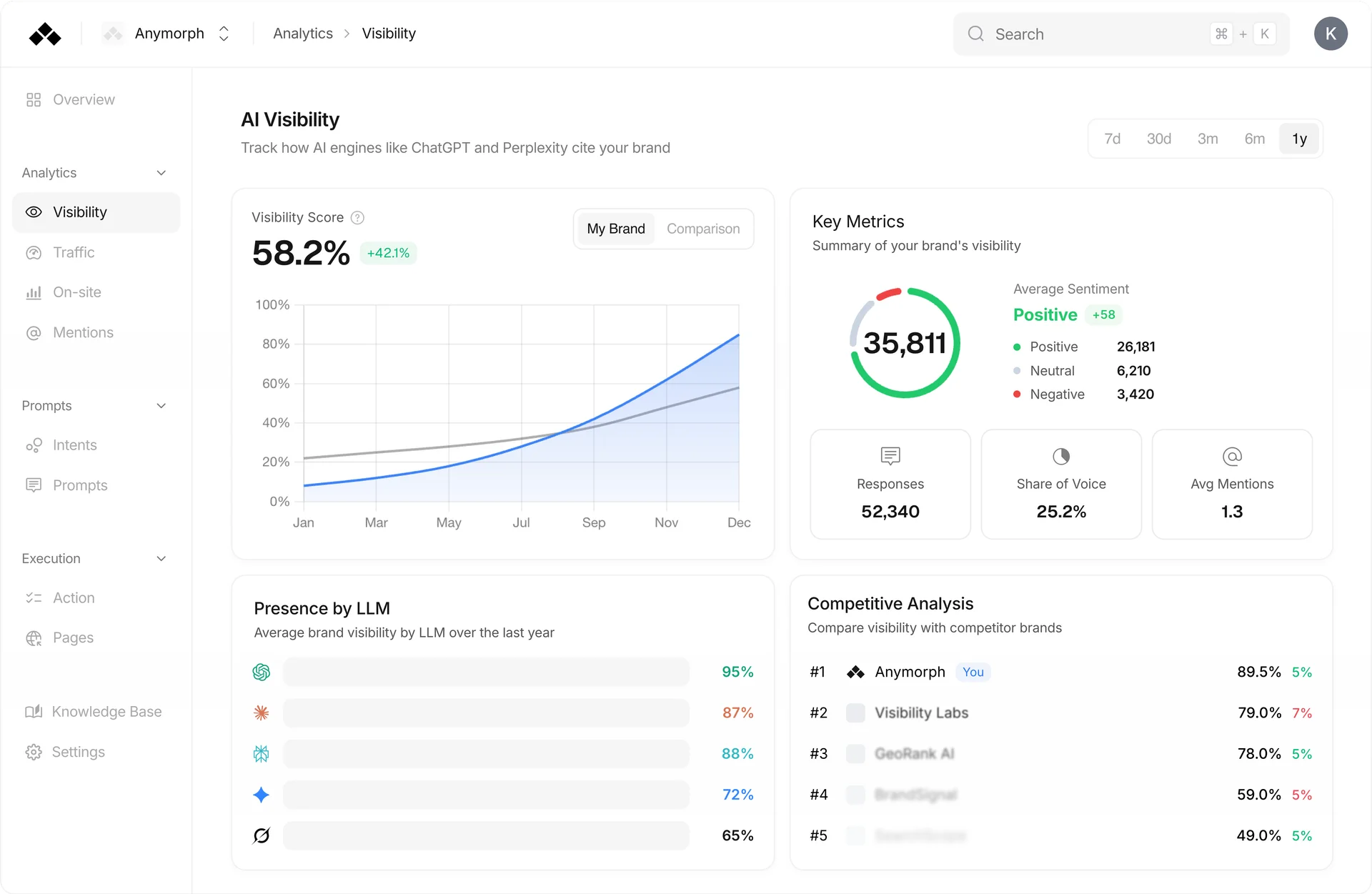
Because zero-click searches are now the majority, brand inclusion within the AI answer itself has become the primary KPI for 2026. If your brand is not the synthesized answer, you are actively losing market share to competitors who have invested in understanding Answer Engine Optimization vs Generative Engine Optimization.

What is the ROI of GEO compared to traditional search strategies?
The ROI of Generative Engine Optimization comes from capturing high-intent AI referral traffic and directly influencing brand-controlled citations.
Once you have established the threat of the discovery shift and the reality of the visibility gap, the conversation with your VP will inevitably pivot to budget and return on investment (ROI). The most persuasive element of a GEO pitch is demonstrating the unprecedented level of control a brand can exert over AI outputs when utilizing the right strategies.
Many executives falsely believe that AI models are impenetrable "black boxes" that cannot be influenced. Research decisively disproves this. Data from 2025 indicates that 86% of AI citations originate from brand-controlled sources, such as official web assets, technical documentation, and controlled public listings.
The transition to AI-integrated optimization workflows is already yielding massive returns for early adopters. Over 83% of companies with more than 200 employees reported measurable SEO and visibility gains after adopting AI optimization into their marketing workflows by 2026.
How to pitch the D.E.E.P. framework to marketing leadership?
To secure VP-level buy-in, you cannot simply present the problem; you must present a concrete, structured solution. We recommend utilizing the D.E.E.P. framework, which has become the industry-standard methodology in 2026 for pitching and executing GEO across enterprise organizations.
Define (Identify your AI battlegrounds)
Explain to leadership that you will not boil the ocean. You will identify the specific, high-intent themes, use cases, and comparative queries (e.g., "best enterprise CRM for healthcare") where the brand absolutely must appear as a recommended solution.
Explore (Audit current AI visibility)
Commit to analyzing your brand's current visibility across the distinct generative engines. Show them that you understand the difference between how ChatGPT, Perplexity, and Google AI Overviews process information.
Evaluate (Quantify the citation gap)
Quantify the "citation gap" between your brand and the competitors who are currently stealing your AI search market share. If a competitor is cited 80% of the time and your brand is cited 10%, this creates an urgent, measurable delta.
Plan (Execute the optimization sprint)
Present a structured roadmap for content optimization to secure those brand-controlled citations. Outline how you will update technical documentation and deploy statistical evidence to make your brand the most citable entity in your niche. Reference a 90-Day GEO Strategy for SaaS.
How do you measure Generative Engine Optimization success?
Success in Generative Engine Optimization is measured by tracking brand inclusion within AI answers and calculating AI-driven referral traffic growth. Traditional metrics like click-through rate (CTR) and keyword ranking positions are insufficient for GEO.
Brand Inclusion Rate
The percentage of times your brand is mentioned when users prompt an AI with non-branded, category-level queries.
Citation Share of Voice (SOV)
How frequently your specific web properties are hyperlinked as the source material within an AI response, compared to your competitors.
Sentiment & Positioning
Whether the AI describes your product accurately, highlighting your specific unique value propositions rather than hallucinating outdated features.
High-Intent Referral Traffic
Tracking the specific sessions originating from ChatGPT, Perplexity, and Claude using custom UTM parameters and referrer data.
For a deeper dive into structuring these metrics for executive review, building a GEO monthly reporting framework and KPIs will ensure your VP has the dashboards they need.
What is the first step to transitioning from SEO to GEO?
The first step involves auditing your current brand visibility across major generative AI platforms. The "Discovery Shift" is no longer a theoretical risk. Waiting to implement a GEO strategy is an implicit choice to lose market share.
Frequently Asked Questions
What is the difference between traditional SEO and Generative Engine Optimization?
Traditional SEO focuses on optimizing web pages to rank as a clickable link on search engine results pages based on keyword algorithms. Generative Engine Optimization (GEO) focuses on structuring content with deep semantics, verifiable statistics, and direct answer capsules so that generative AI models synthesize and cite your brand directly within their conversational answers.
How much traffic do AI search engines actually drive?
AI referral traffic is growing exponentially. As of 2025, AI referral traffic reached 7 billion monthly visits globally, representing a 76% year-over-year growth. By 2026, it accounts for 1.08% of total website visits across key industries, with ChatGPT driving the vast majority (87.4%) of those specific referrals.
Can brands actually control what ChatGPT or Perplexity says about them?
Yes. AI models are heavily reliant on the authoritative data they ingest. Because 86% of AI citations originate from brand-controlled sources (such as official websites, technical documentation, and structured data), brands that proactively optimize their content for AI ingestion can directly influence how they are recommended and compared in AI answers.
Why shouldn't we just wait for Google to figure out AI search?
Waiting is a significant risk due to the fragmentation of AI search. Currently, there is only an 11% overlap between the domains cited by ChatGPT and Perplexity. If you only optimize for Google's traditional or AI ecosystem, you are leaving your brand entirely invisible to the millions of users making high-intent queries on standalone platforms like Claude, Perplexity, and ChatGPT.
How long does it take to see ROI from a GEO strategy?
Because AI models continuously scrape and update their retrieval-augmented generation (RAG) databases, changes made through a structured GEO campaign can be reflected in AI answers much faster than traditional SEO link-building campaigns. Many enterprise organizations report measurable visibility gains within the first 60 to 90 days of implementing a targeted citation gap strategy.