
How to Adapt Your SEO Strategy for Google AI Overviews (2026)
Google AI Overviews appear in 48% of queries as of 2026.
To recover lost traffic, brands must shift from traditional search engine optimization to Generative Engine Optimization (GEO).
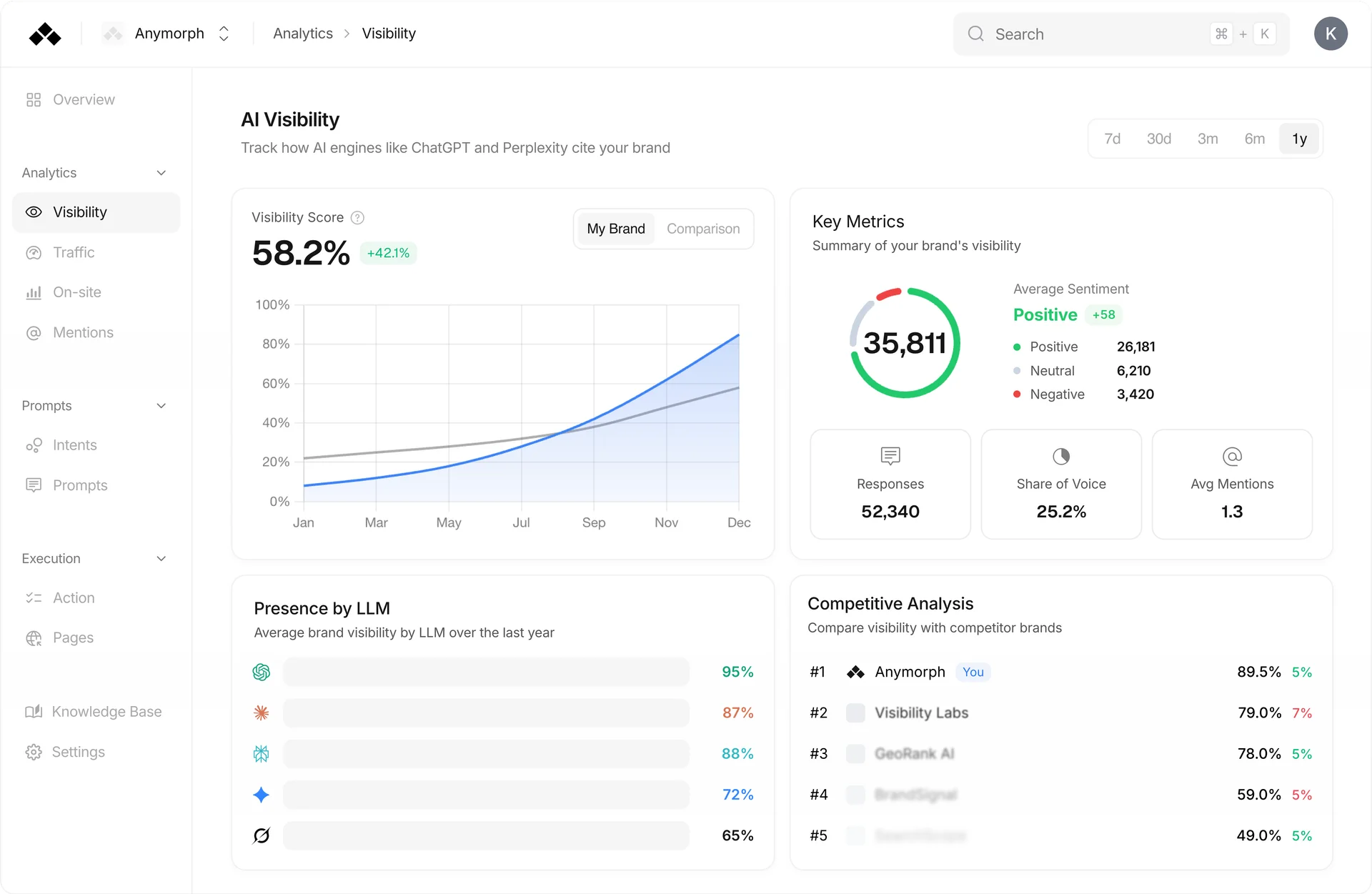
The Collapse of Traditional Rankings
Historically, ranking on the first page of Google meant your content would naturally be sourced for featured snippets. In the generative era, this correlation has collapsed. Only 38% of Google AI Overview citations come from top-10 organic results as of 2026.
Anymorph analysis shows that "ranking-readiness" no longer equals "citation-readiness." The overlap between top-10 traditional organic results and AIO citations plummeted from 76% in 2024 to a mere 38% by March 2026. This volatility is driven by constant underlying language model updates, making tracking competitor mentions in AI search critical.
When Google deployed the Gemini 3 model, it reshuffled the entire ecosystem, instantly replacing 42% of previously cited domains with new sources.
High-Vulnerability Industries
Certain sectors act as "high-trigger" zones for Google's Search Generative Experience. The AI engine deems conversational, aggregated answers highly relevant for these audiences.
- Healthcare 88% Exposure
- Education 83% Exposure
- B2B Technology 82% Exposure
Key Ranking Factors for AI Overviews
To understand Google AI Overviews ranking factors, content teams must unlearn the habit of producing bloated, keyword-stuffed articles. Surprisingly, 53% of citations in AI panels are sourced from concise pages containing fewer than 1,000 words.
1. Structured Data Dependency
2. Query-Fan-Out Integration
3. Information Density
7-Step SEO Recovery Plan
If your site has experienced a Google Search Generative Experience traffic drop, traditional SEO audits will not fix the issue. You must execute a specialized recovery plan centered on citation-readiness and implement a 90-day GEO strategy.
Identify the AIO Pattern
Optimize for Sub-Queries
Audit for Schema Saturation
Monitor Competitor Replacement
Build Brand Authority
Increase Citation Density
Track the 'Citation Lift'
Protect Your Organic Search Pipeline
Relying on traditional blue-link SEO in 2026 is a recipe for a 61% traffic decline. Anymorph is an autonomous website operating system that creates and maintains on-brand content optimized specifically for AI search engine citations. Calculate your share of voice in AI search today.
Book a demoFrequently Asked Questions
How do Google AI overviews affect click-through rates to a website?
Google AI Overviews create a massive divergence in click-through rates. For traditional organic links pushed below the AI panel, CTR drops by 61%. Websites cited in Google AI Overviews experience a decrease in click-through rates of approximately 61%.
What are the best practices for ranking in Google AI Overviews in 2026?
The best practices involve Generative Engine Optimization (GEO). You must structure content in clear, "answer-first" blocks, use exact schema markup (FAQPage, Article, HowTo), optimize for hyper-specific sub-queries rather than broad keywords, and keep answers concise, as 53% of cited pages are under 1,000 words.
Will Google AI Overviews impact SEO traffic permanently?
Yes. Analysts predict that traditional search engine search volume will drop by an additional 25% by 2026 as users fully pivot to AI chatbots and generative interfaces. Adapting to a citation-first SEO strategy using GEO tools is required for long-term survival.
How does Google AI choose which sources to cite in an overview?
Google utilizes a technical mechanism called "FastSearch" and "query-fan-out." Instead of evaluating an article as a whole, the AI breaks the user's prompt into smaller sub-queries, hunts for the most direct, schema-rich answers across the web for those specific micro-intents, and blends them into a single summary. To track this, you need specialized AI visibility analytics.