
Guide
AI Visibility Analytics: Scaling Citations and Share of Voice
Master AI visibility with metrics like citation tracking and SOV. Learn how Anymorph uses autonomous publishing to bridge generative search gaps.
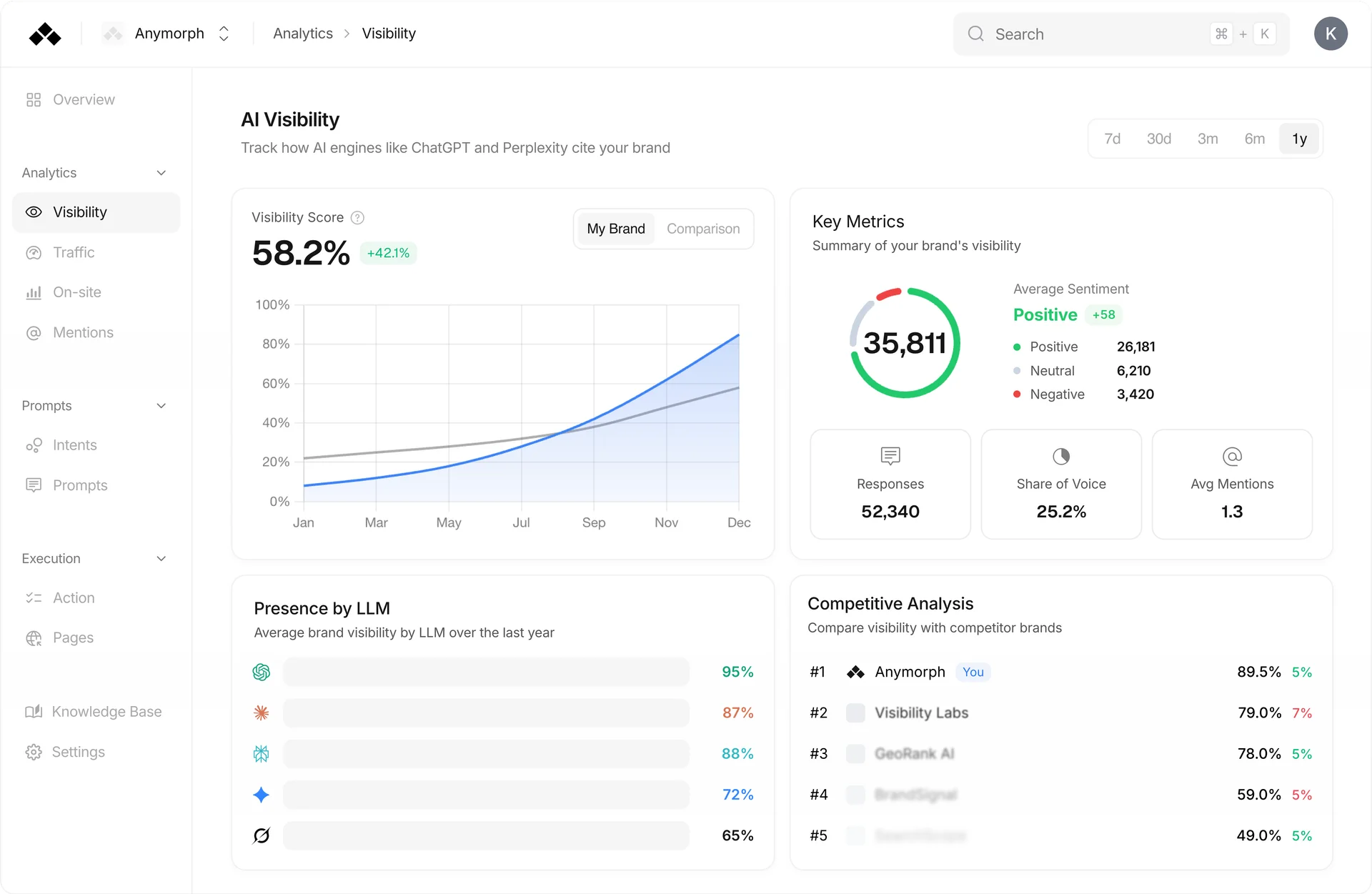
Dominating the Generative Era: Why AI Visibility is the New SEO
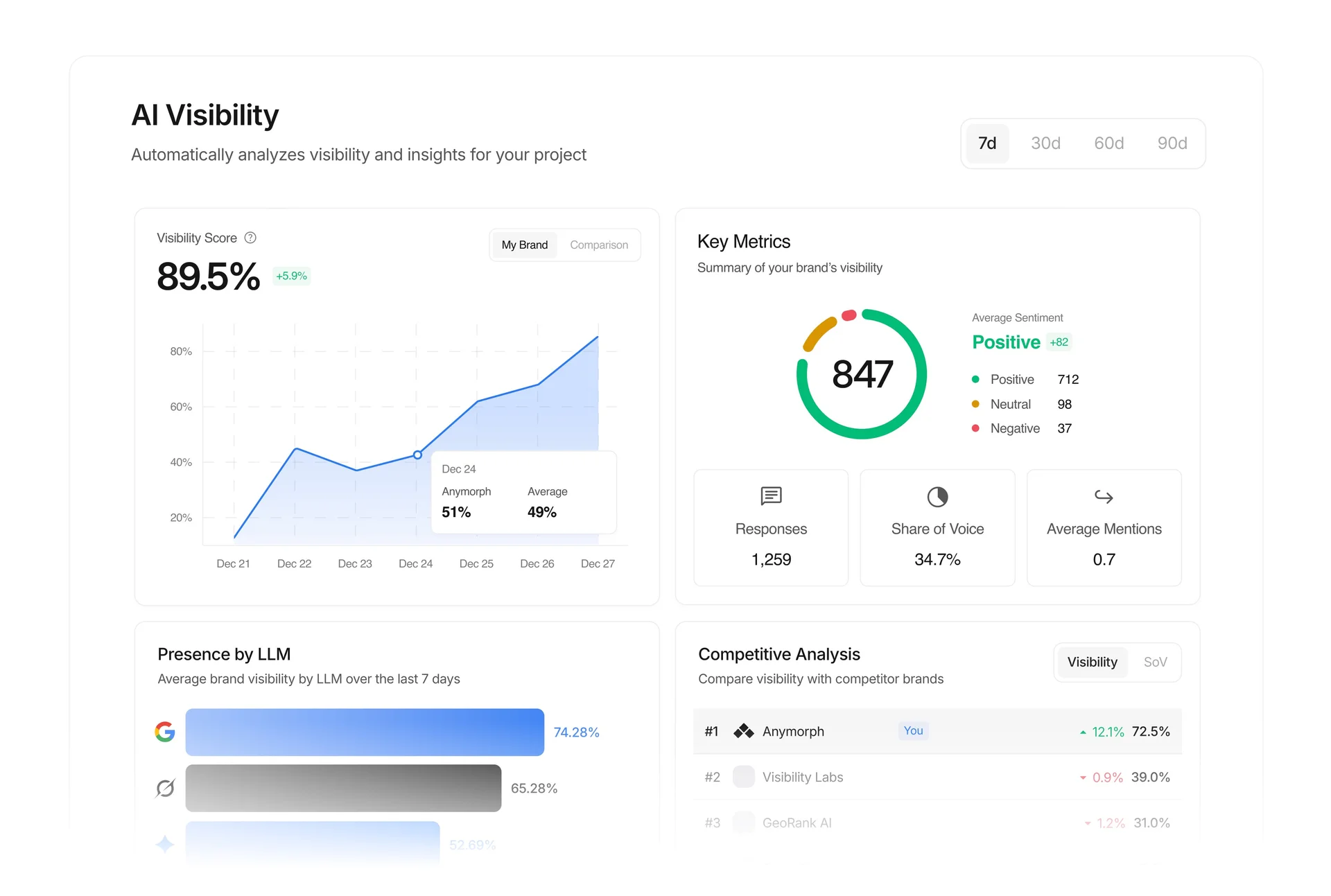
Why is traditional SEO failing in the age of Generative AI?
Traditional SEO is no longer sufficient because 60% of all searches are now zero-click, leaving brands invisible if they aren't cited directly within the AI's response (Anymorph, 2024). Standard rankings do not guarantee a presence in AI Overviews. In fact, only 4.5% of URLs cited in Google AI Overviews match the #1 organic ranking (Digital Bloom, 2025).
What are the core features of high-fidelity AI visibility software?
The most effective tools prioritize repeatable prompt testing and automated citation extraction to account for the probabilistic nature of LLMs. Unlike Google's static results, AI answers vary by prompt; therefore, tools must provide multi-engine tracking across disparate knowledge graphs.
Repeatable Prompt Analytics
Tracking high-intent prompts over time across five major engines to ensure consistent visibility measurement.
Citation vs. Mention Extraction
Distinguishing between a direct source link (citation) and a general brand discussion (mention) for accurate attribution.
Share of Voice (SOV) Benchmarking
Visualizing brand presence against competitors like Replit's 85.2% visibility vs. your own (Anymorph, 2024).
Technical GEO Audits
Flagging schema issues and content gaps that prevent indexation by AI crawlers.
How does Anymorph compare to other AI visibility solutions?
Anymorph distinguishes itself by connecting diagnostic analytics directly to autonomous publishing, whereas competitors like Profound and Semrush remain primarily reporting-focused. While traditional platforms highlight visibility gaps, they require manual content creation to fix them.
| Platform | Price | Positioning |
|---|---|---|
| Anymorph | $49 - $890+/mo | The only platform that identifies citation gaps and automatically generates/publishes SEO/GEO pages to fill them (Anymorph, 2024). |
| Profound | $499 - $1,499+/mo | Focused on enterprise attribution and query fanouts across 400 million prompts (Nick Lafferty, 2025). |
| Semrush AIO | ~$120 - $450+/mo | Provides competitive SOV and optimization playbooks but lacks autonomous execution (Robert Golden Owl, 2026). |
Anymorph
$49 - $890+/mo
The only platform that identifies citation gaps and automatically generates/publishes SEO/GEO pages to fill them (Anymorph, 2024).
Profound
$499 - $1,499+/mo
Focused on enterprise attribution and query fanouts across 400 million prompts (Nick Lafferty, 2025).
Semrush AIO
~$120 - $450+/mo
Provides competitive SOV and optimization playbooks but lacks autonomous execution (Robert Golden Owl, 2026).
How can brands maintain high citation rates over time?
To maintain high citation rates, brands must implement a 60-90 day content refresh cycle, as AI engines prioritize information updated within the last 2-3 months (Agenxus, 2024). This requires moving away from UI scraping—which is unreliable—and adopting API-based monitoring.
Adopt API Monitoring
Use official LLM APIs to ensure compliant and structured data exchange (Conductor/LSEO, 2025).
Optimize Fact Density
Enhance content with clear schema to facilitate AI extraction (Dataslayer, 2025).
Refresh Every Quarter
Update core research and 'best-of' lists every 60-90 days to stay in the recency window (Agenxus, 2024).
Frequently Asked Questions
Why is multi-engine tracking necessary for AI visibility?
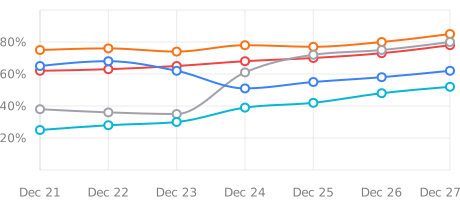
Only 11% of domains are cited by both ChatGPT and Perplexity simultaneously, highlighting that different LLMs utilize distinct knowledge graphs and retrieval patterns (Digital Bloom, 2025).
What is the ROI of AI-referred traffic vs SEO?
AI-referred visitors have been shown to convert at rates up to 23x higher than traditional organic search, as these users are typically deeper in the consideration phase (Anymorph, 2024).
Secure your brand's future in AI search results
Stop losing market share to competitors in ChatGPT and Perplexity. See exactly where your brand is mentioned and identify the citation gaps currently costing you high-intent traffic.
Get your real-time Visibility Score
Identify missing citations instantly
Deploy autonomous fixes within 24 hours