
AI Search vs Mobile-First vs Voice Search: What Marketers Need to Know
The 2026 search market has split into three distinct modalities. While mobile drives 63% of total query volume, AI search platforms are rapidly capturing Gen Z, and voice assistants process 31% of all queries. Marketers face a 64.82% zero-click rate, requiring a massive shift from traditional SEO to Generative Engine Optimization (GEO) to remain visible.
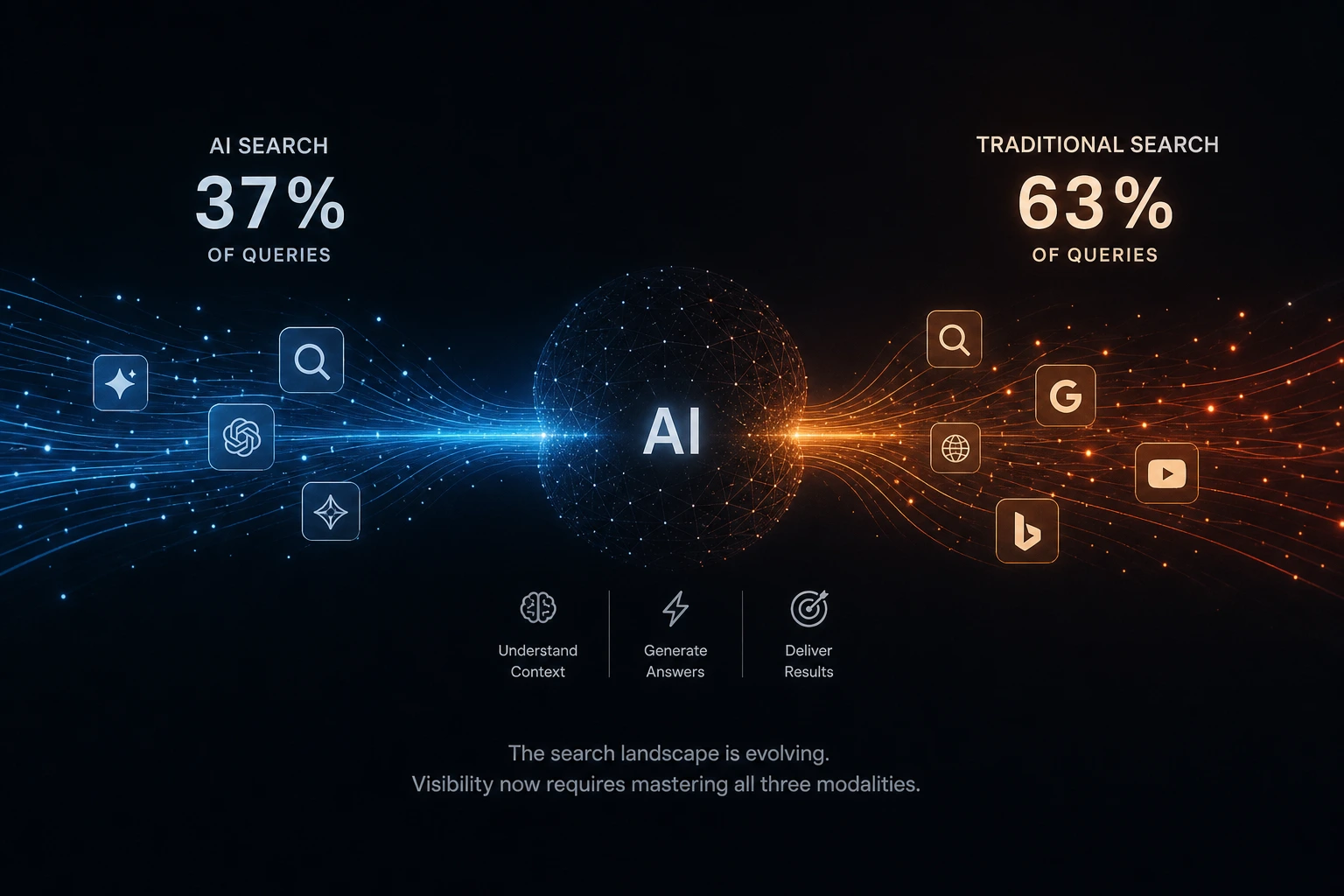
How has the search market share shifted in 2026?
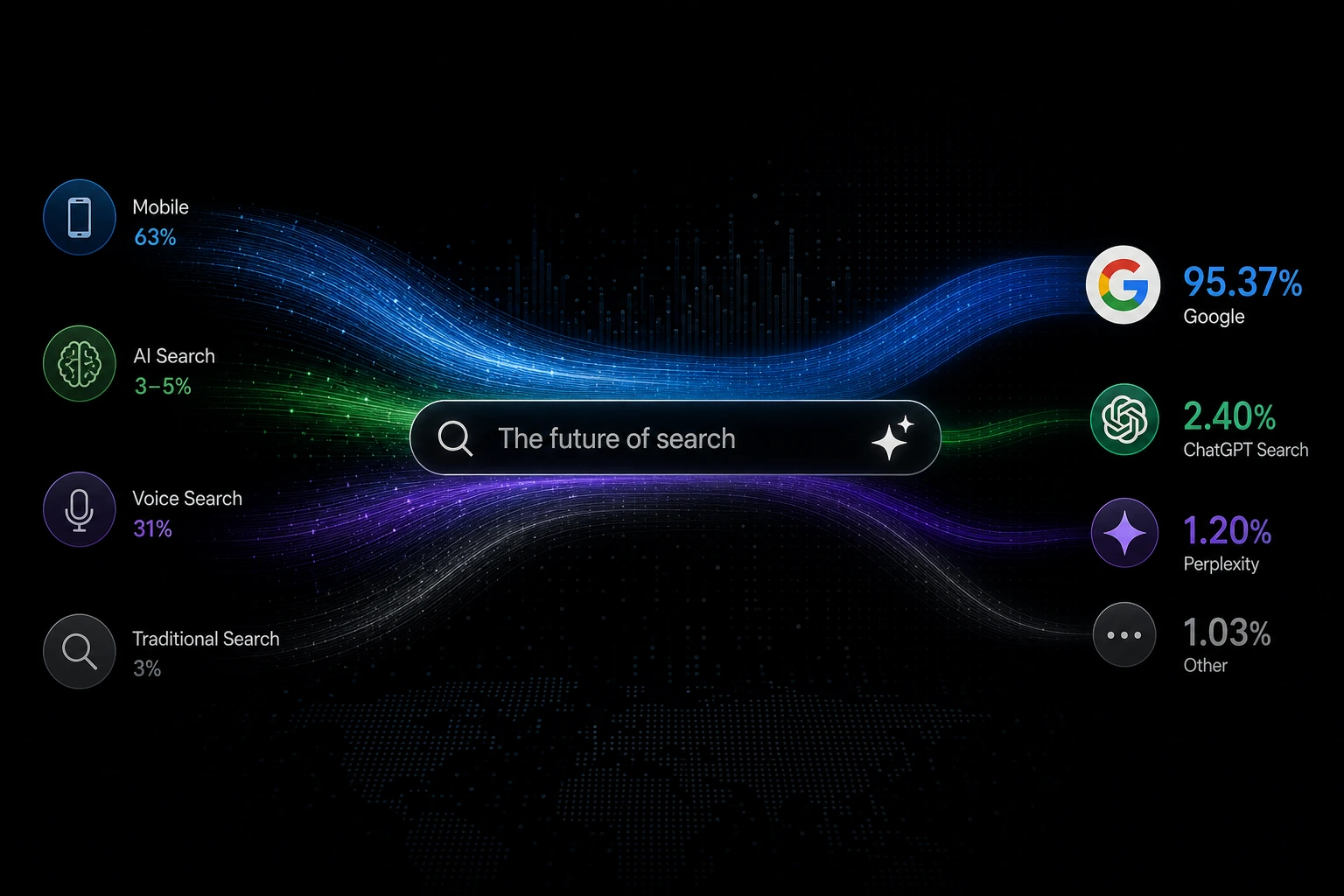
The 2026 search market is highly fragmented, as mobile devices process the most volume while AI rapidly captures Gen Z users. The era of relying on a single dominant search interface is over. While mobile devices continue to account for 63% of all global search queries as of 2026, user loyalty is splitting across multiple distinct ecosystems. Within the mobile sector, Google maintains a formidable 95.37% market share, securing its position as the default utility for hardware-integrated search.
However, specialized Generative AI engines are aggressively capturing market share at the top of the funnel. Generative AI search platforms, led by ChatGPT Search and Perplexity, have secured a combined market share of 3-5%. The user base for these platforms is massive; ChatGPT Search handles 400 million weekly active users as of early 2026.
Simultaneously, voice search has evolved from a niche feature into a ubiquitous utility. Voice commands now represent 31% of all search queries globally, supported by an active voice assistant base that reached 8.4 billion units worldwide.
The most disruptive shift is demographic. AI search adoption is heavily skewed toward younger demographics. In the United States and the European Union, 37% of users aged 18-24 now utilize AI chatbots as their primary source for product research, effectively bypassing traditional search engines altogether. Brands that fail to adapt their AI search playbook for SEO-first teams risk complete invisibility among future core buyers.
What is the difference in query intent across modalities?
Search intent directly correlates with the interface modality, shifting from short navigational terms to highly conversational prompts. Marketers can no longer write generic content and expect it to rank universally; they must align their content structure with how users speak, type, and prompt across different modalities.
| Search Modality | Average Query Length (2026) | Primary User Intent |
|---|---|---|
| Traditional Google | 3–4 words | Navigation & Quick Facts |
| AI Search | 8–12 words | Research, Synthesis & Comparison |
| Voice Search | 29 words | Conversational & Hands-free Tasks |
Traditional Google queries remain highly transactional and navigational. Users rely on shorthand (e.g., "best CRM software") to retrieve quick links. In contrast, AI search users treat engines like research assistants, utilizing 8-12 word prompts to demand synthesized comparisons (e.g., "Compare the best CRM software for a remote sales team of 50 people").
Voice search answers average 29 words in length. Voice search accuracy for standard English is projected to surpass 96% by 2028. Furthermore, to address growing privacy concerns, 38% of these voice queries are now processed entirely on-device rather than in the cloud. This requires marketers to build highly localized, natural-language FAQ sections that directly answer spoken questions.
Why is the zero-click search crisis accelerating?
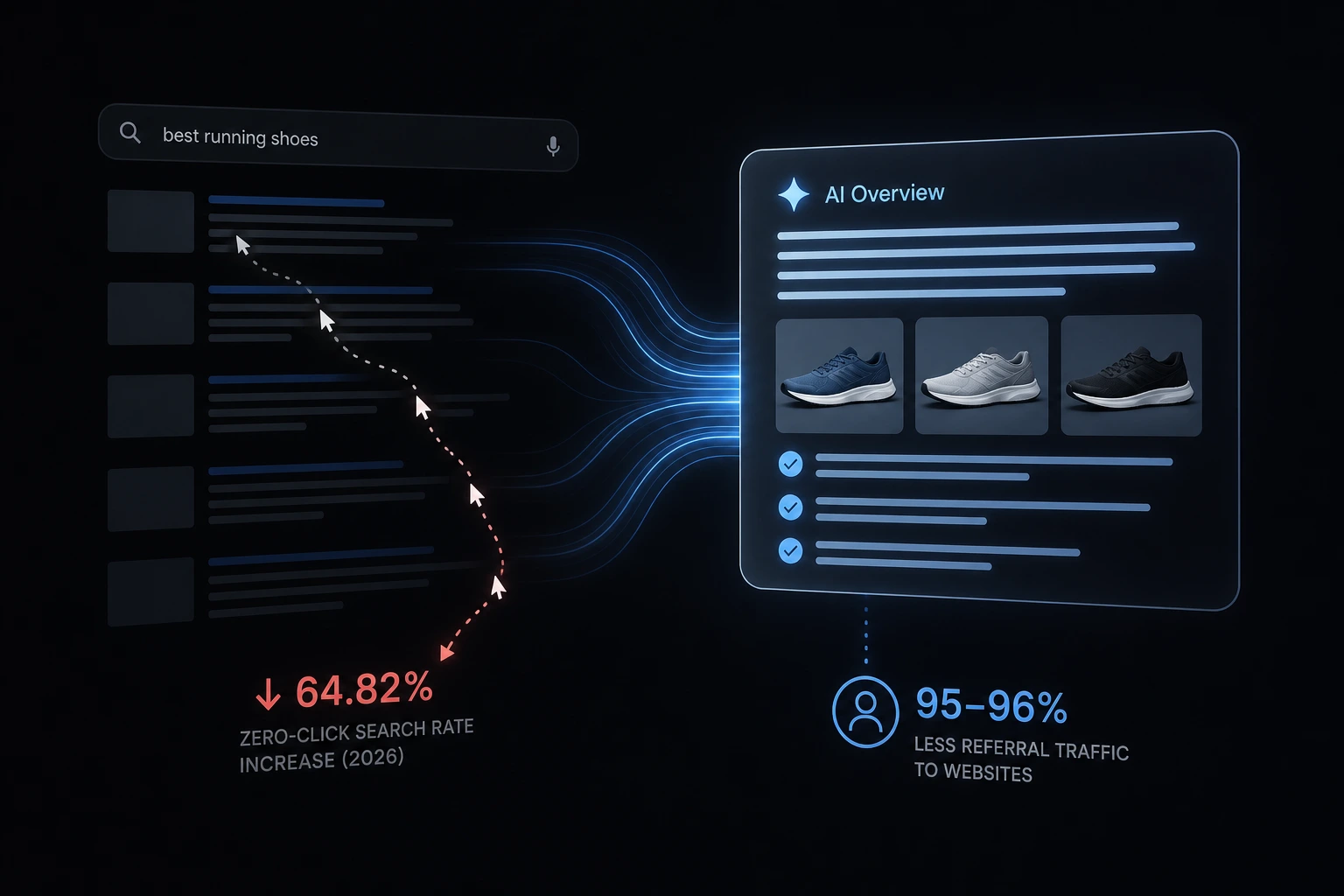
Artificial intelligence features directly answer queries on the results page, eliminating the need for users to click external website links. For over two decades, the social contract of search was simple: search engines crawled publishers' content, and in return, they sent organic traffic. In 2026, that contract is broken. The overall zero-click search rate has risen to an unprecedented 64.82%.
This zero-click phenomenon is particularly devastating on mobile interfaces, where screen real estate is limited. On mobile devices, the zero-click rate climbs to 77.2%, driven primarily by the ubiquity of Google AI Overviews and zero-click widgets that push traditional organic blue links below the fold.
The consequence for publishers and brands is a drastic reduction in top-of-funnel website visits. AI chatbots drive 95-96% less referral traffic to publishers than traditional search engines. This necessitates a total re-evaluation of brand visibility KPIs. Marketing teams can no longer measure success solely by website sessions; they must track brand mentions, citations, and inclusion rates directly within the AI responses themselves.
How are Google AI Overviews impacting organic traffic?
Google's response to standalone AI chatbots has been the aggressive integration of AI Overviews at the top of its traditional Search Engine Results Pages (SERPs). As of 2026, Google AI Overviews appear for 35% of all informational queries.
When an AI Overview triggers, it completely alters the user's journey. Instead of scrolling through 10 organic links to piece together an answer, the user reads the generative summary and often abandons the search immediately. This interface shift has caused an average organic click-through rate (CTR) reduction of 34.5% for traditional search results that previously held top-ranking positions.
Marketing leaders must urgently adapt their SEO strategy after Google AI Overviews. Winning traffic now requires optimizing specifically for the citation carousels embedded within the AI Overviews, rather than fighting for the obsolete "Position 1" blue link below it.
What is Generative Engine Optimization (GEO)?
Generative Engine Optimization is the practice of structuring website content to be cited and recommended by artificial intelligence search engines. As traditional SEO yields diminishing returns, GEO has emerged as the primary mechanism for digital visibility. The goal of GEO is not merely to rank a webpage on an index, but to train Large Language Models (LLMs) to view your brand as the definitive, canonical source of truth for a specific topic.
AI search ranking factors prioritize "decision-grade" content. These models are programmed to synthesize expert opinions, making them highly sensitive to Experience, Expertise, Authoritativeness, and Trustworthiness (E-E-A-T). Sites displaying clear E-E-A-T signals see a 3x increase in citation frequency within AI Overviews compared to domains lacking these signals.
Anymorph recommends upgrading standard blog content into primary source material. This involves publishing proprietary data, original methodologies, and expert perspectives that AI models cannot confidently generate on their own. When your brand owns the underlying facts, AI engines are forced to cite your domain.
How does agentic discovery change product research?
Agentic discovery occurs when autonomous AI tools proactively research, synthesize, and recommend products on behalf of the human consumer. We are shifting from an era of human-driven search to one of agent-driven discovery. In 2026, strategy is shifting toward optimizing for autonomous AI agents that research and recommend products in the background. Rather than a user typing a query, an AI agent takes a complex prompt like "Find me the most cost-effective supply chain software for a mid-sized retailer and summarize the pricing tiers."
To ensure a brand is discoverable by these AI researchers, marketers must implement heavy use of structured data and build strong cross-platform authority. AI agents rely heavily on schema markup, structured tables, clear pricing pages, and verified customer reviews on third-party platforms to build confidence in a recommendation. If an AI agent cannot easily parse your product's value proposition and pricing structure in machine-readable formats, it will simply recommend a competitor whose data is properly structured.
What does the future of search volume look like by 2028?
Traditional search engine query volume will steadily decline in the coming years as voice commerce and autonomous AI handle routine user queries. The current trajectory points to a permanent structural decline in traditional navigational search. Forecasting models project that traditional search volume will decline by 25% by 2028, as AI agents become fully capable of handling routine, multi-step tasks that previously required human browsing.
Simultaneously, voice modalities will evolve from simple command-and-control interfaces into massive transactional ecosystems. Despite the overall decline in traditional search behavior, voice-driven commerce is expected to reach an astonishing $164 billion by 2028. Consumers will increasingly rely on smart speakers, automotive assistants, and wearables to reorder supplies, book services, and make low-friction purchases using strictly verbal commands.
How can marketers adapt their strategy for AI search visibility?
The transition from SEO to GEO requires a fundamental upgrade in content architecture and performance measurement. Anymorph analysis shows that brands succeeding in the 2026 market have abandoned keyword stuffing in favor of semantic richness, structured data, and highly opinionated expert content.
Audit for AI Readiness
Ensure all product features, specifications, and pricing data are wrapped in detailed schema markup. Audit your content to improve how AI engines understand and cite your pages.
Measure Share of Voice
You must measure share of voice in AI search across platforms like ChatGPT, Claude, and Perplexity to understand your true visibility, rather than just tracking Google Search Console.
Deploy Autonomous Content
Maintain an agile website infrastructure that can instantly adapt content to match the evolving algorithms of AI engines.
Anymorph operates as an autonomous website OS that automatically creates and maintains on-brand, decision-grade content precisely engineered for AI search citations. See how Anymorph connects your proprietary insights directly to the AI platforms your buyers use today.
Book a DemoFrequently Asked Questions
What is the difference between voice search and AI search?
Voice search refers to the input modality—using spoken language instead of typing to query a device (like a smart speaker or smartphone). AI search refers to the processing engine that synthesizes answers from multiple sources to generate a conversational response, rather than just returning a list of links. Today, many voice assistants use AI search on the backend to generate their spoken answers.
How do I optimize my content for a 64% zero-click search environment?
If users are not clicking through to your site, your goal is to be the brand mentioned in the zero-click answer. You achieve this by providing clear, direct answers to common questions at the very top of your webpages, using structured data, and building strong E-E-A-T (Expertise, Experience, Authoritativeness, Trustworthiness) signals so AI models trust your domain as a primary source.
Why is traditional search volume projected to drop by 2028?
Traditional search volume will decline by an estimated 25% because autonomous AI agents will take over routine tasks. Instead of a user executing ten different searches to plan a business trip or compare software vendors, the user will give one prompt to an AI agent, which will execute the research autonomously and return a final synthesis.
What are "E-E-A-T signals" in the context of Generative Engine Optimization?
E-E-A-T stands for Experience, Expertise, Authoritativeness, and Trustworthiness. For AI engines, these signals include named authors with verified credentials, first-party data and research, citations from other high-authority websites, and transparent sourcing. AI models are statistically more likely to cite domains that display strong, verifiable expertise.