AI Search Share of Voice Tools vs Prompt Testing Tools
Compare AI share of voice tools and prompt testing tools for B2B SaaS visibility, citations, pricing, and GEO execution in 2026.
AI search share of voice tools measure recurring brand presence across generative engines. Prompt testing tools benchmark isolated queries or pages.
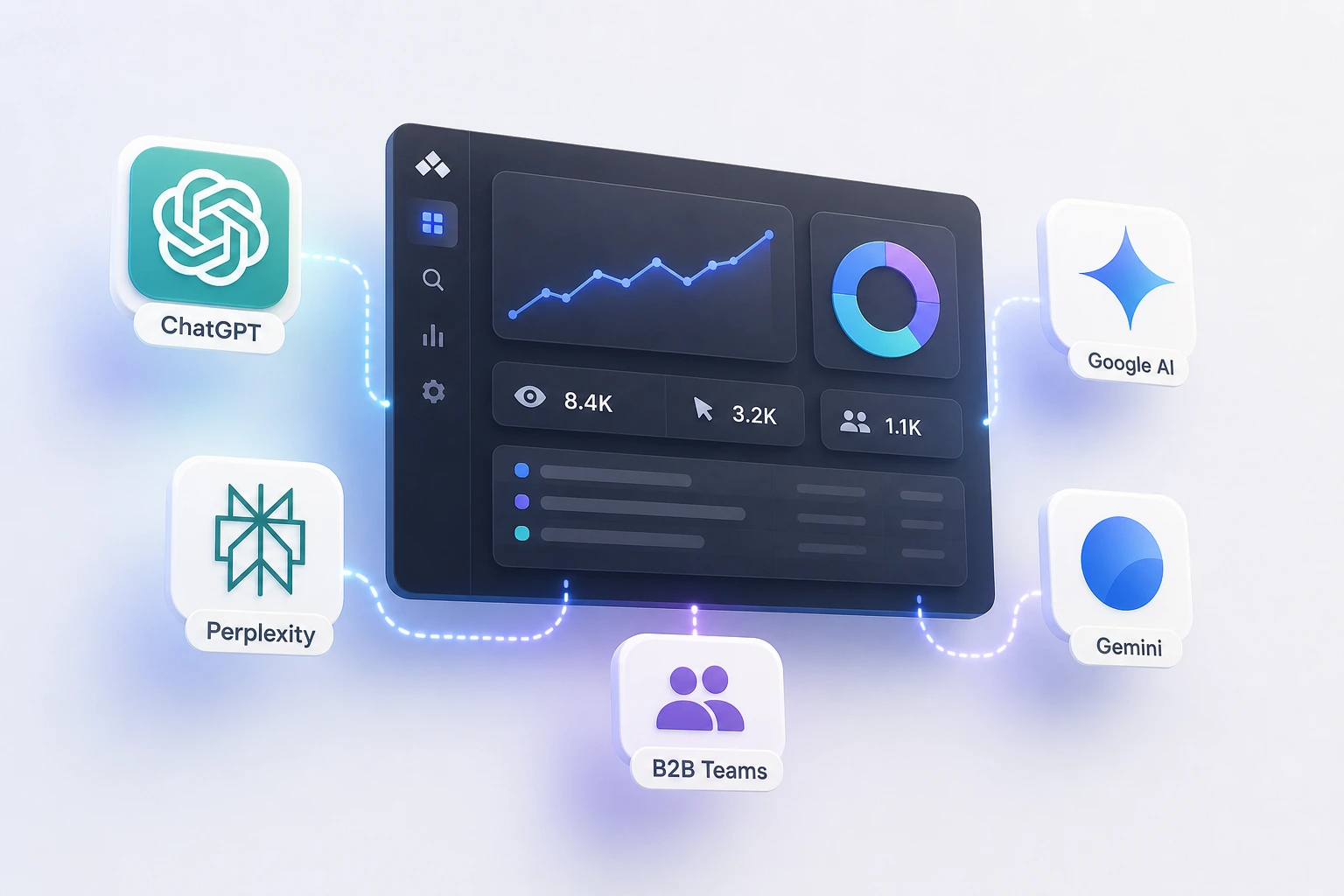
For B2B SaaS teams, the practical choice depends on the job. If a marketing leader needs weekly visibility, competitor share, citation analysis, and content priorities across ChatGPT, Perplexity, Gemini, Claude, and Google AI Overviews, a share of voice platform is the better fit. If an SEO lead needs to test how one landing page appears for a handful of commercial prompts, a prompt testing tool can be enough.
Why is AI search visibility growing for B2B SaaS?
AI search visibility now affects B2B pipeline because buyers use generative engines for vendor research before they visit websites.
As of April 2026, 73% of B2B buyers use AI tools such as ChatGPT and Perplexity for purchase research (Metro Atlanta CEO, 2026). That shift makes generative engine optimization, or GEO, a commercial visibility problem rather than an experimental SEO side project.
The business reason is conversion quality. AI-referred visits convert at 14.2%, compared with 2.8% for Google organic search (Metro Atlanta CEO, 2026). The same analysis describes AI-referred traffic as having a 5.1x conversion advantage over traditional search (Metro Atlanta CEO, 2026).
The tracking gap is still wide. Only 22% of marketers actively monitor their brand visibility inside generative AI engines (Metro Atlanta CEO, 2026). That means many teams can see organic rank, paid search spend, and website conversion, but cannot see whether AI engines recommend them when buyers ask comparison questions.
For SaaS teams, commercial evaluation prompts represent a critical visibility challenge. These queries determine whether a brand appears during the research phase when buyers compare vendors and seek alternative solutions within their specific category.
A prompt test can show one answer at one point in time. Identifying brand presence helps marketers understand how their company is represented in generative search results.
Why do traditional SEO tools fall short for generative AI?
Traditional rank tracking reports differ from how generative engines display information, as AI engines rely heavily on varied citations and community sources like Reddit.
Standard rank tracking does not fully explain AI answers. Practitioner analysis in 2026 found that approximately 80% of URLs cited by ChatGPT do not rank within the top 100 results on Google Search (QuickSEO.ai, 2026). A page can be invisible in traditional rank reports and still influence an AI answer.
The engines also cite different parts of the web. Only 11% of domains are cited by both ChatGPT and Perplexity in the B2B SaaS ecosystem (Averi.ai, 2026). That small overlap is the reason a single-engine prompt check can mislead a marketing team.
Citation density also varies by engine. ChatGPT generates an average of 10.4 citations per response, while Perplexity AI generates an average of 21.9 citations per response (QuickSEO.ai, 2026). Perplexity’s source mix also has a community signal, with Reddit accounting for 46.7% of top-10 citations in the cited B2B SaaS benchmark (Averi.ai, 2026).
These mechanics change the workflow. A SaaS team needs to know which prompts matter, which engines mention the brand, which competitors appear instead, which URLs are cited, and which pages should be created or updated. Traditional SEO tools can still support technical search health, but they do not replace AI citation tracking.
What are AI search share of voice tools?
AI search visibility tools can track brand presence and citations across multiple generative engines.
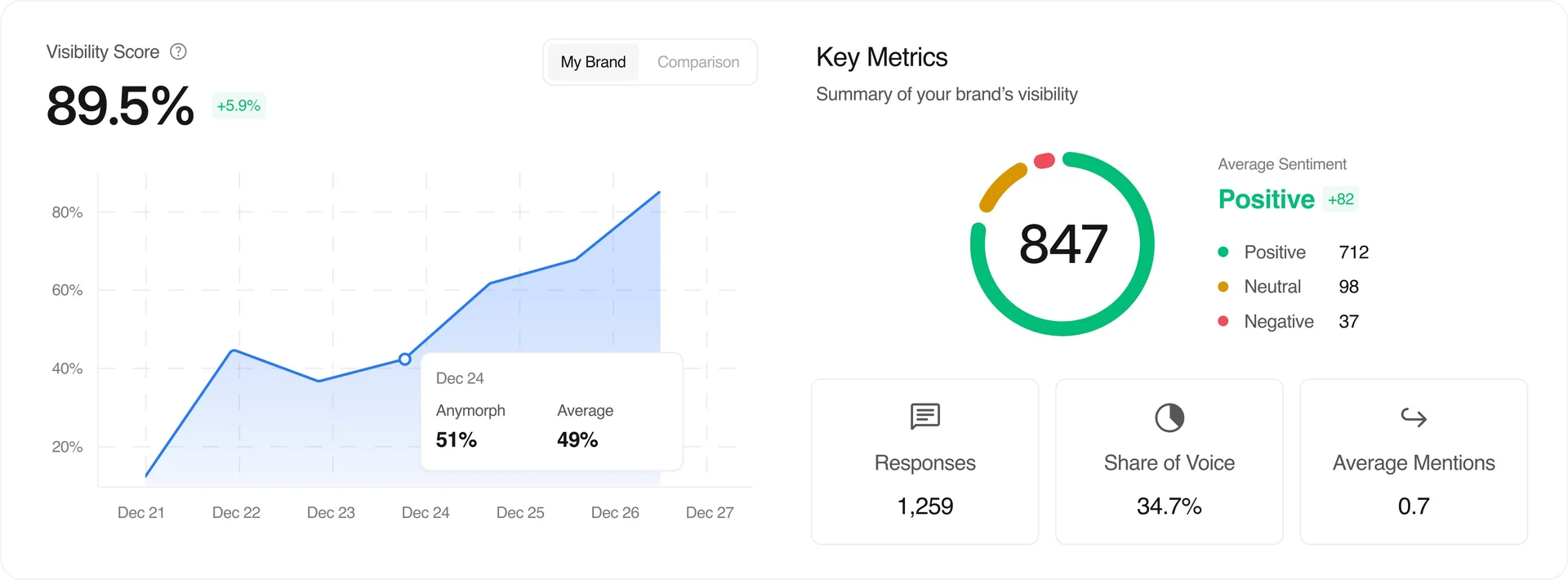
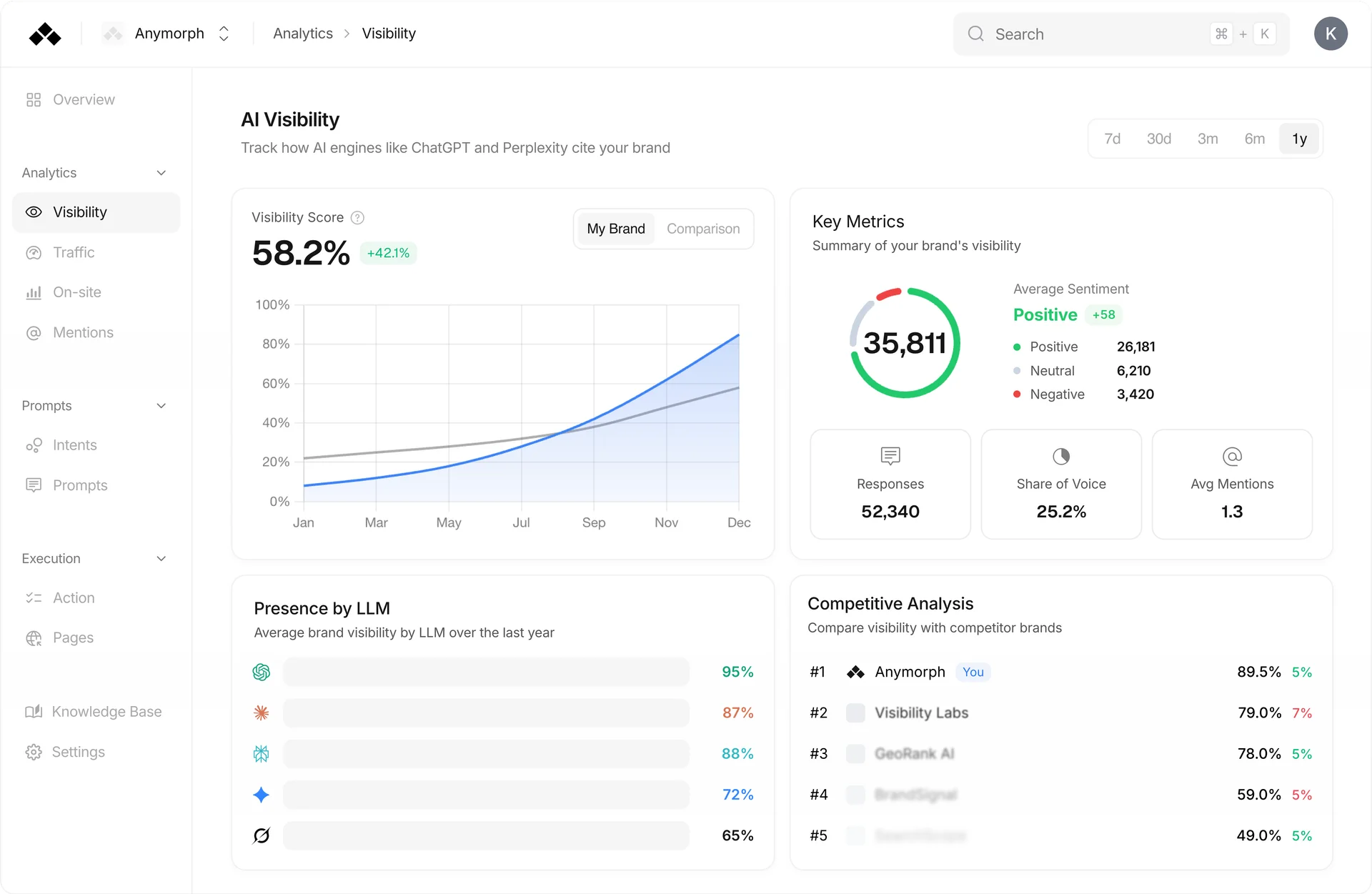
Share of voice tools allow marketing teams to track brand visibility inside generative AI engines. Platforms like Scrunch AI monitor a user-configured set of prompts across multiple engines to provide visibility data. The best fit is a team that needs recurring reporting and a defensible way to prioritize GEO work.
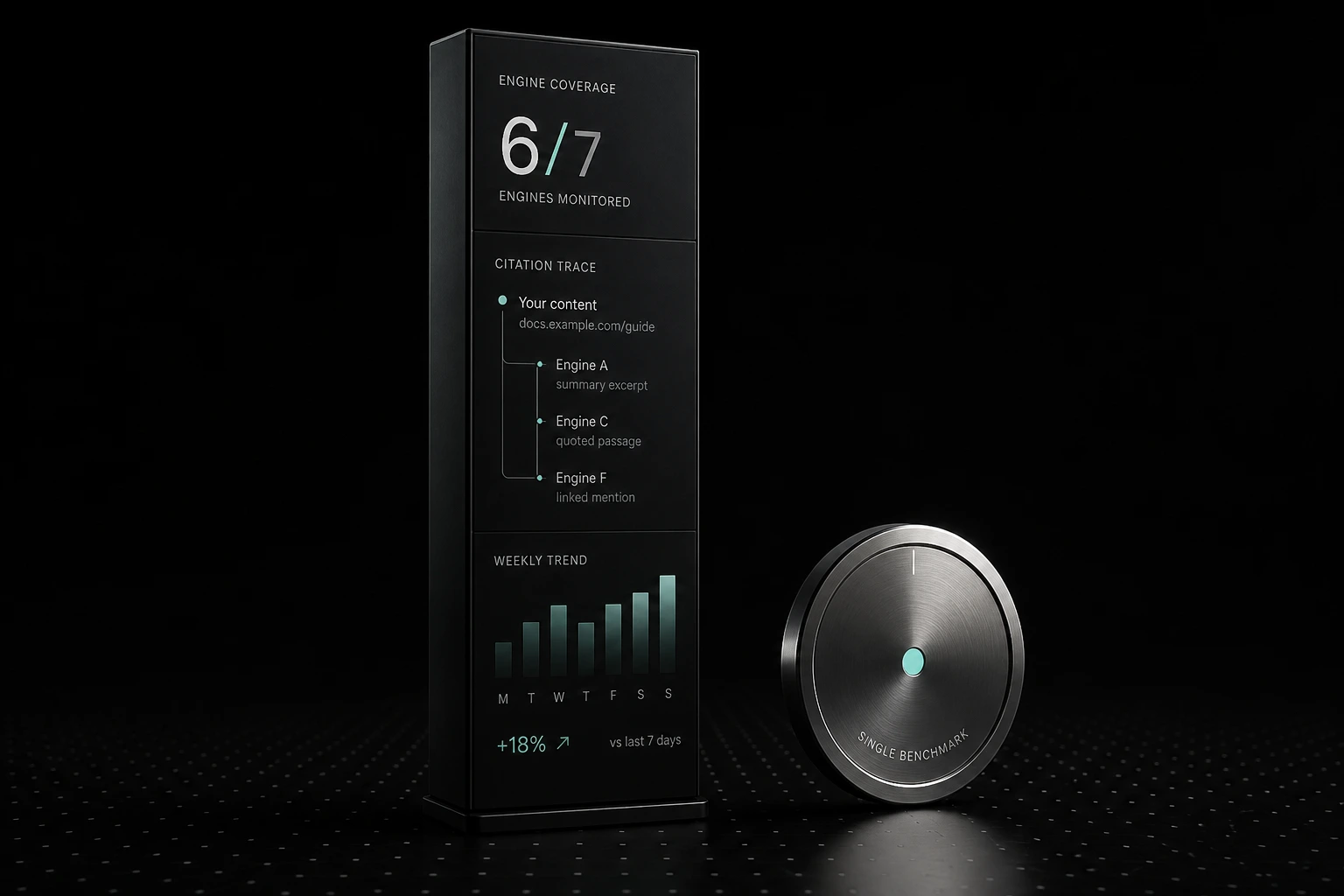
Scrunch AI is a common reference point in this category. SE Ranking describes Scrunch AI as providing visibility monitoring and citation tracking across 4 to 7 generative engines (SE Ranking, 2026). The same source notes SOC2 compliance and GA4 integration for direct traffic attribution (SE Ranking, 2026).
A true AI visibility platform should help answer five operational questions:
- Which engines mention our brand for buyer-intent prompts?
- Which competitors are mentioned when we are missing?
- Which cited sources influence the answer?
- Which content gaps explain the missing mentions?
- Which pages should be created, refreshed, or repositioned next?
Evaluating content influence is an important step following measurement. This process helps teams understand which sources are retrieved and summarized in AI responses, providing insights into how content is being utilized by generative engines.
Share of voice tooling is most useful when the buying journey crosses several AI engines. A B2B SaaS prospect may ask ChatGPT for a shortlist, use Perplexity to verify sources, check Google AI Overviews for category summaries, and return to a vendor website only after the brand has already been framed by third-party answers.
What are prompt testing tools?
Prompt testing tools like Peec AI benchmark specific pages, making them useful for isolated experiments rather than continuous market monitoring.
Prompt testing is narrower by design. Tools in this category allow teams to conduct prompt SEO experiments to see how specific configurations impact AI search results. SE Ranking describes Peec AI as a tool for isolated, page-level benchmarking and prompt SEO experiments (SE Ranking, 2026).
That makes prompt testing useful for tactical questions:
- Does this product page appear when the prompt includes our category and target segment?
- Does adding clearer comparison language change the LLM response?
- Which claims are repeated, omitted, or misunderstood?
- Does a page update improve one high-value commercial prompt?
- How do answers differ when the prompt names a competitor?
Prompt testing tools are also more accessible for some teams. Entry pricing for prompt testing tools such as Rankscale and Peec AI is approximately $95 per month (SE Ranking, 2026). That lower entry point can make sense for a content lead validating a small prompt set before a larger GEO investment.
The limitation is scope. While prompt testing identifies page-level performance, it focuses on individual experiments rather than the broader market observability offered by multi-engine monitoring platforms. Teams that rely only on manual prompt runs often end up with screenshots, spreadsheets, and unclear next steps.
Share of voice vs. prompt testing: which strategy do you need?
Choose share of voice for recurring market visibility. Choose prompt testing for page-level experiments and limited prompt benchmarks.
The category distinction is not about which tool is more advanced. It is about the decision the team needs to make. A CMO needs to know whether the brand is visible across buying prompts and competitors. An SEO manager may need to know whether one optimized page improves a specific answer. Both workflows are valid, but they answer different questions.
| Evaluation dimension | AI search share of voice tools | Prompt testing tools |
|---|---|---|
| Primary job | Measure ongoing brand presence across AI engines | Test specific prompts, pages, or LLM outputs |
| Best user | CMO, VP marketing, growth lead, SEO lead | SEO lead, content strategist, GEO specialist |
| Engine coverage | Multi-engine monitoring across major answer engines | Often narrower, depending on plan and setup |
| Reporting cadence | Recurring dashboards and trend reporting | Reruns, experiments, or one-time benchmarks |
| Competitor tracking | Core workflow | Limited or prompt-specific |
| Citation analysis | Core workflow for finding source gaps | Useful when included, but not always central |
| Content recommendations | Expected in mature platforms | Often limited to audit findings |
| Page generation | Rare in monitoring-only tools, included in Anymorph’s workflow | Usually outside the product scope |
| Attribution | Stronger when connected to analytics tools | Usually not the main workflow |
| Buying fit | Teams managing GEO as a channel | Teams validating individual prompt hypotheses |
The simplest rule is this: if the question begins with “How visible are we across the market?”, use a share of voice platform. If the question begins with “What happens when we change this page or prompt?”, use a prompt testing tool.
Anymorph fits teams that want the monitoring layer and the execution layer in one workflow. The platform tracks AI visibility across seven-plus engines, analyzes competitor and citation gaps, and creates on-brand pages designed to answer the prompts buyers are already asking.
What capabilities matter beyond monitoring?
Teams need citation analysis, content gap detection, and publishing workflows when AI visibility findings must turn into pages.
Monitoring identifies the problem. Execution fixes it. A GEO workflow should connect the visibility dashboard to the content system, because many visibility gaps are caused by missing, unclear, or outdated pages that AI engines cannot confidently cite.
Look for these capabilities when comparing AI citation tracking platforms:
- Multi-engine coverage for ChatGPT, Perplexity, Gemini, Claude, and Google AI Overviews
- Prompt grouping by category, use case, competitor, and funnel stage
- Competitor share of voice reporting across the same prompt set
- Citation exports that show which domains and URLs influence answers
- Content gap analysis that identifies missing comparison, definition, and use-case pages
- Recommendations that specify what to publish or revise
- Brand controls so generated pages match approved messaging
- Analytics connections that help connect AI visibility to pipeline signals
This is where Anymorph’s product model differs from standalone prompt benchmarking. It treats AI visibility as an operating loop: monitor the engines, identify gaps, generate citation-ready pages, keep those pages current, and preserve brand consistency. That loop is useful for SaaS teams with many products, verticals, integrations, competitors, and use cases.
Who should buy a platform, and who should use a testing utility?
A platform fits teams accountable for market visibility. A testing utility fits specialists validating one prompt set or page update.
Different stakeholders evaluate the same category with different success criteria. The right tool depends on the internal owner.
| Buyer situation | Better fit | Why |
|---|---|---|
| CMO needs AI visibility reporting for board or pipeline reviews | Share of voice platform | The question is recurring market presence, not one prompt result |
| SEO lead needs to compare brand mentions across engines | Share of voice platform | Multi-engine reporting reduces false confidence from a single answer engine |
| Content lead wants to test a rewritten comparison page | Prompt testing tool | The job is a controlled before-and-after benchmark |
| RevOps stakeholder wants attribution from AI traffic | Share of voice platform | Analytics integration matters more than isolated prompt output |
| Early-stage team has five priority prompts and no GEO workflow yet | Prompt testing tool | A small benchmark can validate demand before larger tooling |
| SaaS team needs pages created from AI visibility gaps | Platform with execution workflow | Monitoring is not enough when content production is the bottleneck |
Non-fit language is important. A share of voice platform may be too much if the team only needs a quick screenshot for one prompt. A prompt testing tool may be too narrow if leadership expects trend reporting, competitor movement, citation exports, and repeatable content recommendations.
How should mid-market SaaS teams compare pricing?
Compare total workflow cost, not seat price, because AI visibility work includes monitoring, analysis, writing, publishing, and refreshes.
Public pricing signals show a meaningful gap between categories. Scrunch AI pricing starts between $250 and $300 per month for 350 user-configured prompts, according to SE Ranking’s tool comparison (SE Ranking, 2026). Prompt testing tools such as Rankscale and Peec AI have entry pricing levels of approximately $95 per month (SE Ranking, 2026).
The lower monthly number is not always the lower total cost. A mid-market SaaS team should compare the full workflow:
- How many engines are covered?
- How many prompts are included before overage fees apply?
- Does the tool track competitors and citations, or only prompt outputs?
- Are recommendations specific enough for a content team to act on?
- Does the vendor require services to interpret the data?
- Can the team publish or refresh pages from the findings?
- Does the platform support attribution analysis?
For teams that already have writers, editors, developers, and analytics capacity, prompt testing can be a low-cost diagnostic layer. For teams that need monitoring plus on-brand page creation, Anymorph reduces the operational handoff between visibility data and published GEO content.
How should teams turn AI visibility gaps into GEO pages?
Turn AI visibility gaps into GEO pages by mapping missing prompts to specific buyer questions, cited sources, and content updates.
A practical workflow starts with prompts, not keywords. Commercial prompts reveal how buyers ask AI engines to compare options, shortlist vendors, and verify credibility. The team then maps each missing mention to the page type AI engines need.
- Group commercial prompts by category, use case, competitor, integration, and buyer segment.
- Measure current brand presence, competitor presence, and cited URLs across multiple AI engines.
- Identify prompts where competitors are mentioned but your brand is absent or uncited.
- Check whether your site has a clear, current page that answers the buyer’s question.
- Create or update a citation-ready page with definitions, comparison criteria, evidence, and product context.
- Rerun the prompt set on a recurring cadence and track changes in mentions, citations, and referrals.
Anymorph automates the middle of this workflow. It identifies gaps, generates pages aligned to approved brand context, and maintains those pages as market language changes. That is especially useful when a SaaS company needs pages for many competitor comparisons, integrations, verticals, and use cases.
See how Anymorph handles AI visibility and GEO execution
Book a demo to review how Anymorph monitors AI search presence, finds citation gaps, and generates on-brand pages for buyer prompts.