
How to Add Structured Data for AI Search Programmatically in Next.js
A developer guide to programmatic JSON-LD, Next.js page generation, webhook workflows, and reliable GEO implementation at scale.

The Impact of Structured Data on AI Search Visibility
Structured data provides machine-readable atomic facts, instantly increasing visibility in AI search responses by feeding models efficiently.
Boost in AI Visibility
Complete schema usage is linked to a 43% increase in AI search visibility compared to unstructured text.
Higher Overview Chance
Content utilizing proper schema has an estimated 2.5x higher chance of being featured directly inside AI-generated answers.
Faster Processing
LLMs utilizing structured data process information up to 300% faster and more accurately than parsing plain text.
For detailed strategies on deploying these frameworks across technology brands, exploring Generative Engine Optimization for AI Product Companies reveals how foundational schema directly influences product discovery.
Next.js 15 Programmatic JSON-LD Implementation
When generating millions of pages programmatically, standard hard-coded schema falls short. You need an architecture that maps your database fields directly into Schema.org specifications on the fly.

Because the built-in Metadata API in Next.js 15 does not yet support the injection of arbitrary scripts natively, developers must bypass standard meta-tag generation for JSON-LD. The standard practice involves creating dedicated React components that inject the JSON-LD directly into the DOM utilizing a <script> tag paired with the dangerouslySetInnerHTML attribute.
Safe Implementation & Sanitization
When you pass data directly into dangerouslySetInnerHTML, you bypass React's native cross-site scripting (XSS) protections. Security and sanitization must be the first step in your JSON-LD utility functions.
Developers should replace characters such as < and > with their respective Unicode equivalents (e.g., \u003c and \u003e). This ensures that even if user input contains HTML or JavaScript tags, the browser's parser interprets it strictly as a string literal within the JSON object.
Architecting Atomic Facts & Compound Schema
Generative Engine Optimization fundamentally alters how content is ingested. Instead of optimizing for human click-through rates, modern engineering teams must optimize for machine extraction by decomposing complex narratives into "atomic facts."
4k-Token Context Windows
When an AI crawler evaluates a page, it allocates a specific "context window" for the retrieval phase. Developers must construct atomic facts specifically designed to fit within 4k-token context windows, ensuring they are cleanly cited by LLMs during a single inference pass. If your structured data exceeds these constraints, the AI engine will truncate the data, leading to hallucination or omission.
Compound Schema Signals
A flat schema architecture forces the AI engine to infer relationships. To guarantee extraction, developers must explicitly map these relationships using nested structured data. For advanced 2026 AI optimization, actively nest FAQPage schema directly inside the primary Article or Product schema. This semantic binding dramatically improves extraction confidence.
| Schema Architecture | Relationship Mapping | AI Extraction Confidence | Best Use Case |
|---|---|---|---|
| Flat Schema | Implicit (Separate tags) | Moderate | Simple blogs, static homepages |
| Compound Schema | Explicit (Nested arrays) | Very High | Programmatic guides, dynamic product catalogs |
| Graph Schema | @id Node Linking | Maximum | Enterprise knowledge bases, interconnected wikis |
Automating Schema Delivery & CI/CD Validation
When deploying programmatic pages built on Next.js, content freshness is critical. AI search engines are heavily biased toward real-time accuracy; out-of-date schema can cost a brand its positioning within hours.
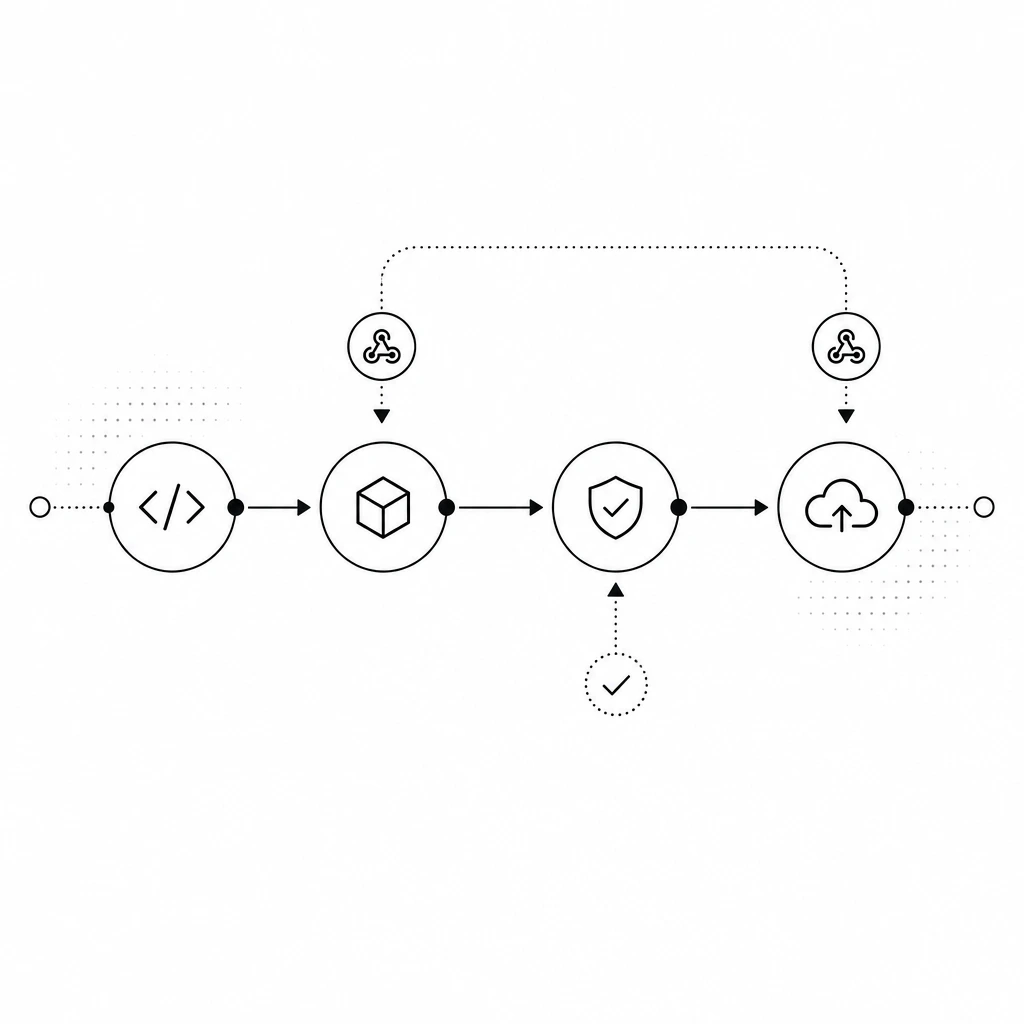
- Webhook Workflows: Automation workflows must utilize webhooks to trigger IndexNow pings and facilitate immediate sitemap generation the exact moment content is updated in the CMS or database.
- CI/CD Validation: Programmatic schema is powerful, but a single typo can invalidate the entire script tag. Validation must shift left, becoming a non-negotiable gate in your CI/CD pipelines.
- Automated Crawling: Use GitHub Actions integrated alongside tools like Puppeteer or Playwright to crawl the actual rendered HTML of your Next.js application during the build phase to validate JSON-LD properties before deployment.
For teams seeking complete solutions, integrating a GEO Platform with Autonomous Page Generation streamlines this exact push-pull workflow without requiring manual intervention.
Accuracy Penalties & Reliable GEO Architecture
The future of AI search emphasizes data verification as much as data ingestion. Inaccurate, stale, or deliberately misleading structured data will face active penalties, with AI engines choosing to penalize the domain entirely rather than just bypassing the faulty JSON-LD block.