
Anymorph | 15% to 35% is a Good AI Citation Rate for SaaS
TL;DR: A competitive AI citation rate for B2B SaaS entities ranges from 15% to 30% for commercial queries. Performance is measured in four distinct bands based on engine architecture and query intent, requiring weekly audits to maintain visibility and prevent pipeline loss due to rapid model updates.
Run a free domain analysis with Anymorph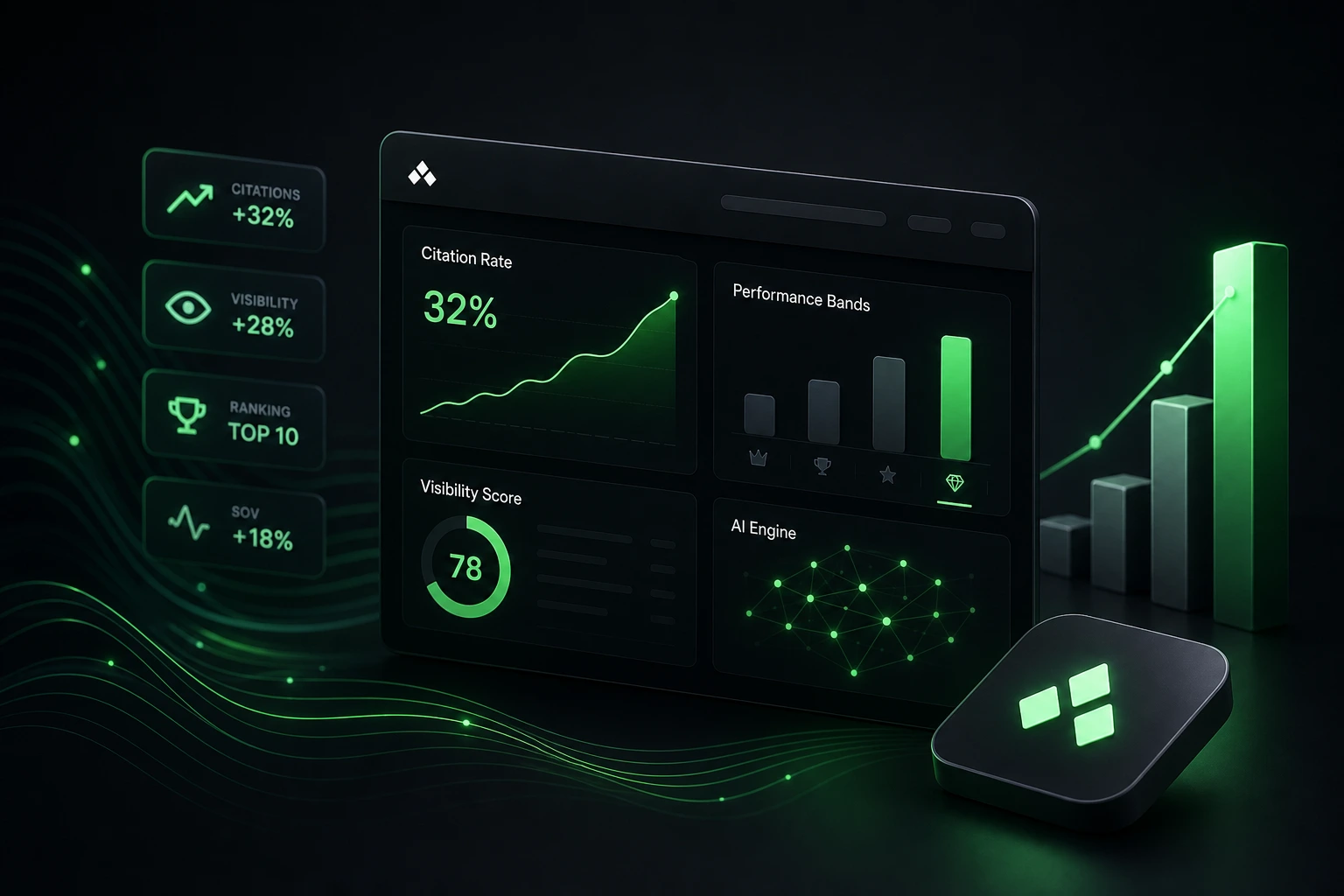
What is a good AI citation rate for B2B SaaS?
A competitive AI citation rate for established B2B SaaS brands falls between 15% and 35% across high-intent commercial queries.
As of May 2026, AI citation metrics have fully replaced Click-Through Rate (CTR) as the primary key performance indicator for Generative Search Engine (GSE) visibility. Entities operating in the top 5% of their category achieve citation rates exceeding 40% by structuring their domains specifically for Retrieval-Augmented Generation (RAG) frameworks (ArXiv, 2026). Measuring this success requires auditing domain mentions, linked outputs, and entity recommendations within AI-generated responses.
Instead of treating visibility as a single binary metric, marketing operations teams evaluate performance through categorized thresholds. When an AI engine generates an answer, it selects from millions of potential data nodes. Securing a 25% citation rate means that in one out of every four relevant queries generated by target buyers, the AI model explicitly names and links your product as a viable solution. This metric directly correlates with middle-of-funnel pipeline volume. Companies falling below these benchmarks experience a "discovery gap," meaning prospective buyers using AI to research software categories never encounter the brand during their evaluation phase.
What are the 4 performance bands for AI visibility?
B2B SaaS brands fall into four citation bands: Dominant (over 35%), Competitive (15% to 35%), Emerging (5% to 14%), and Negligible (below 5%).
These tiers dictate how often an AI engine treats a brand as an authoritative source for industry-specific queries. The Dominant band categorizes "Category Primary" entities that models default to for benchmark answers. The Competitive band encompasses brands frequently included in "Top 10" lists, comparison tables, and buyer guides (Gartner, 2026). This is the standard target range for established mid-market SaaS companies seeking sustainable growth.
| Performance Band | Citation Rate | Typical SaaS Positioning | AI Engine Validation Status |
|---|---|---|---|
| Dominant | >35% | Category Primary | Treated as default authoritative source for the category |
| Competitive | 15%–35% | Established Challenger | Frequently listed in "Top 10" and competitor comparison tables |
| Emerging | 5%–14% | Niche Solution | Cited for long-tail technical queries but omitted from category searches |
| Negligible | <5% | Discovery Gap | Insufficient structured data for model validation |
Brands residing in the Emerging tier (5% to 14%) typically capture mentions for highly specific, long-tail technical queries but face complete omissions in broad category searches (BrightEdge, 2026). Companies in the Negligible tier suffer from a severe discovery gap. This indicates that AI models lack the necessary structured and unstructured data required to validate the brand’s market relevance. According to Anymorph's visibility audits, moving out of the Negligible band requires immediate technical interventions to signal entity existence to primary crawlers.
Identify your performance band.
Run a free domain analysis with Anymorph to map your current citation rate across major generative engines.
Run a free domain analysisHow do citation benchmarks vary by AI engine?
Search-centric engines require a 20% to 25% citation rate, while ecosystem-centric engines demand a 15% to 30% baseline for visibility.
Generative engines utilize fundamentally different retrieval architectures, which alters the required thresholds for visibility across platforms. Perplexity and SearchGPT operate as search-centric engines. They prioritize real-time indexing, active web crawling, and high-authority secondary citations. Maintaining a 20% to 25% benchmark on these specific platforms depends heavily on recent public relations velocity, technical documentation freshness, and customer sentiment sourced from review aggregator platforms like G2 (2026).
Conversely, ecosystem-centric engines like Google Gemini and Microsoft Copilot lean on deep-web indices, proprietary networks, and strict technical guidelines. For these models, a 15% to 30% citation rate represents a strong, achievable baseline. Gemini explicitly prioritizes domains exhibiting high "Helpful Content" signals and rigorous technical implementations. Research confirms that properly implemented structured data increases a domain's citation probability by 30% (Schema.org, 2024). Teams optimizing for these ecosystem models must prioritize entity relationships via Schema markup, ensuring the LLM understands exactly what the product does, who it serves, and how much it costs.
What citation rates should you expect by query intent?
Technical documentation queries demand an 80% citation rate, commercial queries require 25%, and informational queries average 10% to 15%.
A single software company will exhibit drastically different visibility metrics depending on the specific prompt a user submits. Target benchmarks shift significantly as users move from broad educational research to direct software implementation.
Informational Queries: For broad educational prompts like "How to optimize SaaS cloud spend," a healthy citation rate hovers at 10% to 15%. These terms carry high search volumes but extreme competition, as LLMs pull from Wikipedia, major news outlets, and broad media aggregators (Backlinko, 2026).
Commercial and Comparison Queries: For middle-of-funnel prompts like "Best CRM for fintech startups," SaaS brands must hit a 25% minimum benchmark. Exclusion from these commercial outputs directly reduces sales pipeline volume and prevents buyer discovery during active evaluation cycles (TechCrunch, 2026).
Technical and Documentation Queries: For precise technical queries like "[Brand] API rate limits," brands must secure an 80% or higher citation rate. Failing to dominate branded technical queries signals a critical failure in website crawlability or technical architecture (W3C, 2026). If a developer asks an AI engine how to implement your product and the engine cites a third-party forum instead of your official documentation, it indicates your core content is functionally invisible to generative parsers.
How does Share of Voice (SOV) relate to AI citations?
Market leaders hold a 40% share of voice in their primary category clusters, while challengers should target a 15% visibility benchmark.
In Generative Engine Optimization (GEO), Share of Voice measures the percentage of total citations within a specific query cluster owned by a single brand. While a standard citation rate tracks how often a brand appears in isolated prompts, SOV measures that appearance relative to all competitors in the exact same output. Understanding Share of Voice in AI Search provides teams with a concrete competitive advantage.
Market leaders dominate their verticals by maintaining a 40% SOV across their primary category queries (Forrester, 2025). This level of dominance ensures the brand acts as the primary recommendation in nearly half of all relevant AI conversations. New SaaS products entering established markets treat a 15% SOV as a highly successful entry point.
Why do citation rates fluctuate so frequently?
AI model weight updates and reinforcement learning cause volatile citation rates, requiring weekly performance reviews to catch visibility drops.
Search algorithms update continuously in the generative era. A software company holding a stable 30% citation rate on Monday might drop to 12% by Friday following a minor model deployment. Generative engines rely heavily on RLHF (Reinforcement Learning from Human Feedback) and continuous fine-tuning, resulting in highly volatile visibility metrics across all major platforms (OpenAI, 2026).
Marketing operations teams must implement weekly reviews to monitor for sudden drops in core branded terms or to catch "Engine Hallucinations" that misrepresent product pricing and capabilities. Monthly reviews serve a broader strategic purpose, identifying specific "Citation Gaps" where competitors secure mentions but the target brand remains omitted. Data freshness heavily dictates these fluctuations. AI engines prioritize content updated within the preceding 90 days. Stale marketing content experiences a 45% decline in AI citation frequency over a standard 6-month period (Wired, 2024). Brands relying on static pages published years ago will see their citation rates erode to zero.
How can SaaS brands improve Generative Engine Optimization?
Brands achieve higher AI citation rates by publishing primary research, writing declaratively, and securing tier-one editorial mentions.
Moving from the Emerging visibility band into the Competitive or Dominant bands requires targeted structural changes to domain content. First, SaaS entities must establish niche authority by publishing peer-reviewed or data-backed primary research that Large Language Models (LLMs) cannot extract from competitor domains (Nature, 2026). Original data forces the AI to cite the source domain directly.
Second, marketing teams must format content for maximum quotability. AI models prefer clear, declarative statements that extract easily for synthesis. Complex, meandering paragraphs reduce the likelihood of a direct citation (ArXiv, 2026). Use distinct noun-verb structures and keep essential facts in the first sentence of a section. Finally, third-party validation acts as a core trust signal for LLM attention weights. High-tier editorial mentions from publications like the Wall Street Journal validate the brand's prominence (2026). Teams that continuously measure and act on these factors rely on automated competitor tracking workflows to identify content gaps and deploy new pages rapidly.
Turn visibility gaps into pipeline.
Deploy your first citation-ready page with Anymorph to establish niche authority and capture commercial intent in AI search.
Deploy your first pageFAQ
What is a good AI citation rate for B2B SaaS?
A competitive AI citation rate ranges from 15% to 35% for commercial SaaS queries across major generative search engines. Entities operating in the top 5% of their category often secure visibility rates exceeding 40%. Performance heavily depends on user intent, with technical queries demanding an 80% baseline to indicate healthy site crawlability.
How do I measure my Share of Voice in AI search?
Measure Share of Voice (SOV) by calculating your total specific citations divided by the total citations of all competitors within a defined query cluster. Market leaders typically maintain a 40% SOV (Forrester, 2025), while new market challengers should target a 15% benchmark to establish basic competitive visibility.
Why did my AI search visibility drop suddenly?
AI visibility drops suddenly due to continuous model fine-tuning and the rapid decay of stale content metrics. Content older than six months experiences a 45% decline in AI citation frequency (Wired, 2024). Marketing teams must review performance metrics weekly to address these algorithmic fluctuations and update outdated documentation.
Does structured data improve Generative Engine Optimization?
Yes, proper implementation of structured data increases a domain's citation probability by 30% (Schema.org, 2024). Ecosystem-centric engines like Google Gemini rely heavily on Schema markup to validate entity relationships, product features, and organizational authority before generating confident answers for users.
Which AI engines should B2B SaaS brands track?
B2B SaaS brands must track search-centric engines like Perplexity and SearchGPT, alongside ecosystem-centric models like Google Gemini and Microsoft Copilot. Each generative engine utilizes distinct retrieval mechanisms, meaning a brand might hold a 25% citation rate on Perplexity but completely fail to appear in Gemini outputs.